

Ithaca island is a small, mountainous gem in the Ionian Sea, forever linked to the legend of Odysseus, and this guide covers everything you need to plan an unforgettable visit.
Set in the sheltered blue channel just east of Kefalonia, Ithaca is the smallest and quietest of the great Ionian Islands, and quite possibly the most romantic name in the whole of Greek geography. This is the kingdom of Odysseus: a rocky, green, almost butterfly shaped island of cypress and olive, of tiny harbours full of masts, of mountain villages where the church bell and the cicadas are the only traffic noise you will hear all day.
Ithaca island is a place that rewards slowness. There are no airports, no resorts, no long strips of sunbeds. Instead there are hidden coves reachable only by boat, a monastery at 600 metres with half the Ionian at its feet, ancient ruins that scholars still argue about, and about three thousand islanders who are, without exaggeration, some of the warmest hosts in Greece. One day you are swimming alone in the emerald water of Gidaki, the next you are eating grilled fish on the quayside at Kioni while the yachts settle for the night.
Ithaca is also having a moment right now. Christopher Nolan’s The Odyssey, released in July 2026 with Matt Damon as Odysseus, has put Homer’s island back on screens worldwide. Though the “Ithaca” in the film is actually Favignana, off Sicily, the real one is here in the Ionian, and you can walk it!
Book your Ithaca island holidays with Ionian & Aegean Island Holidays now!
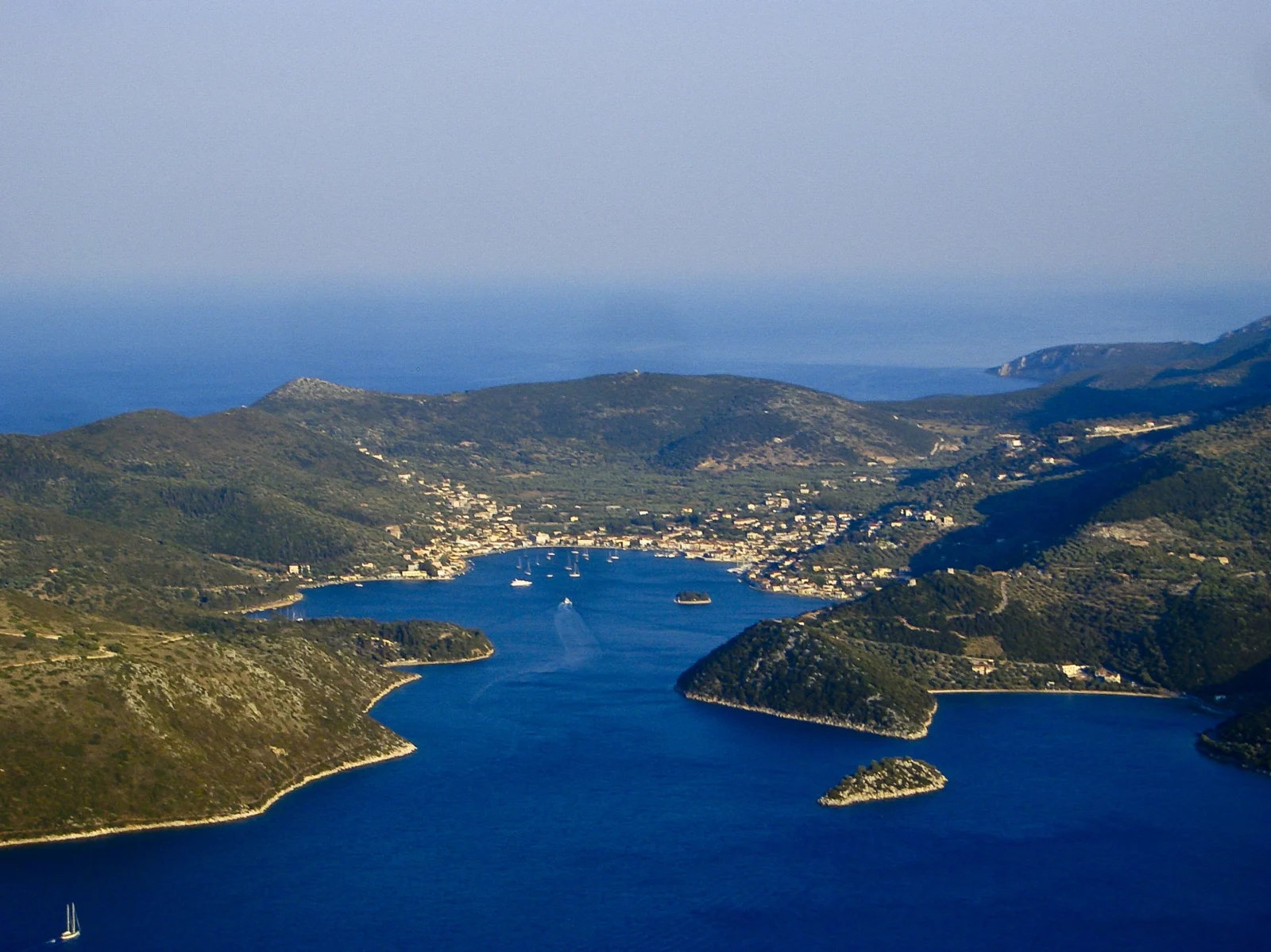
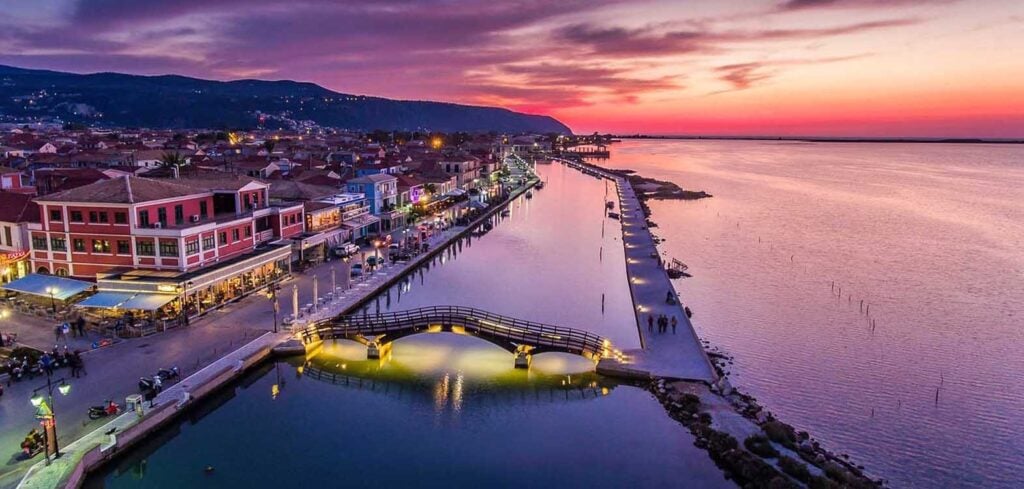
The harbour of Vathy seen from above, with Lazaretto islet in the middle of the bay
No other Greek island carries quite this much literary weight. In Homer’s Odyssey, Ithaca is the destination: the rocky, goat rearing little kingdom that Odysseus spends twenty years trying to reach. Whether the Homeric Ithaca is exactly today’s island has been debated for two centuries, and a well known modern theory even proposed the Paliki peninsula of Kefalonia as the “real” one, but excavation after excavation on Ithaca itself keeps turning up Mycenaean and Geometric period material that fits the story remarkably well.
Archaeology here is genuinely exciting. At Polis Bay near Stavros, the Loizos Cave produced bronze tripod cauldrons of the 9th and 8th centuries BC and a fragment of a clay mask inscribed with a dedication to Odysseus, evidence of a hero cult on the island in antiquity. Above Platrithias, the site known as the School of Homer has been excavated by the University of Ioannina and has revealed a substantial Mycenaean complex, complete with a rock cut staircase and a well, which many now identify with the palace of Odysseus.
After antiquity came Rome, Byzantium, and then centuries of pirate raids so severe that the islanders abandoned the coast and lived inland, at Palaiochora and Anogi. Only under Venetian rule, from the 16th century onwards, did families come back down to the water and found today’s Vathy. The French built a small fortress at the mouth of the harbour in 1807, and the British era that followed brought a boom in shipbuilding: over two hundred vessels were built in Vathy’s yards during the 19th century, and the town’s population climbed to around five thousand. Like the rest of the Ionian, Ithaca joined the Greek state in 1864.
The 20th century was harder. Shipping declined, emigration to Australia, South Africa and the United States hollowed out the villages, and then in August 1953 the Ionian earthquake flattened almost everything, including Vathy. What makes Ithaca special is what happened next: the islanders rebuilt Vathy deliberately in its old scale and colours, low houses with pantile roofs around the horseshoe of the bay, so that the town you see today still feels like the town that was lost. That instinct, to preserve rather than to replace, explains a great deal about the island’s character.
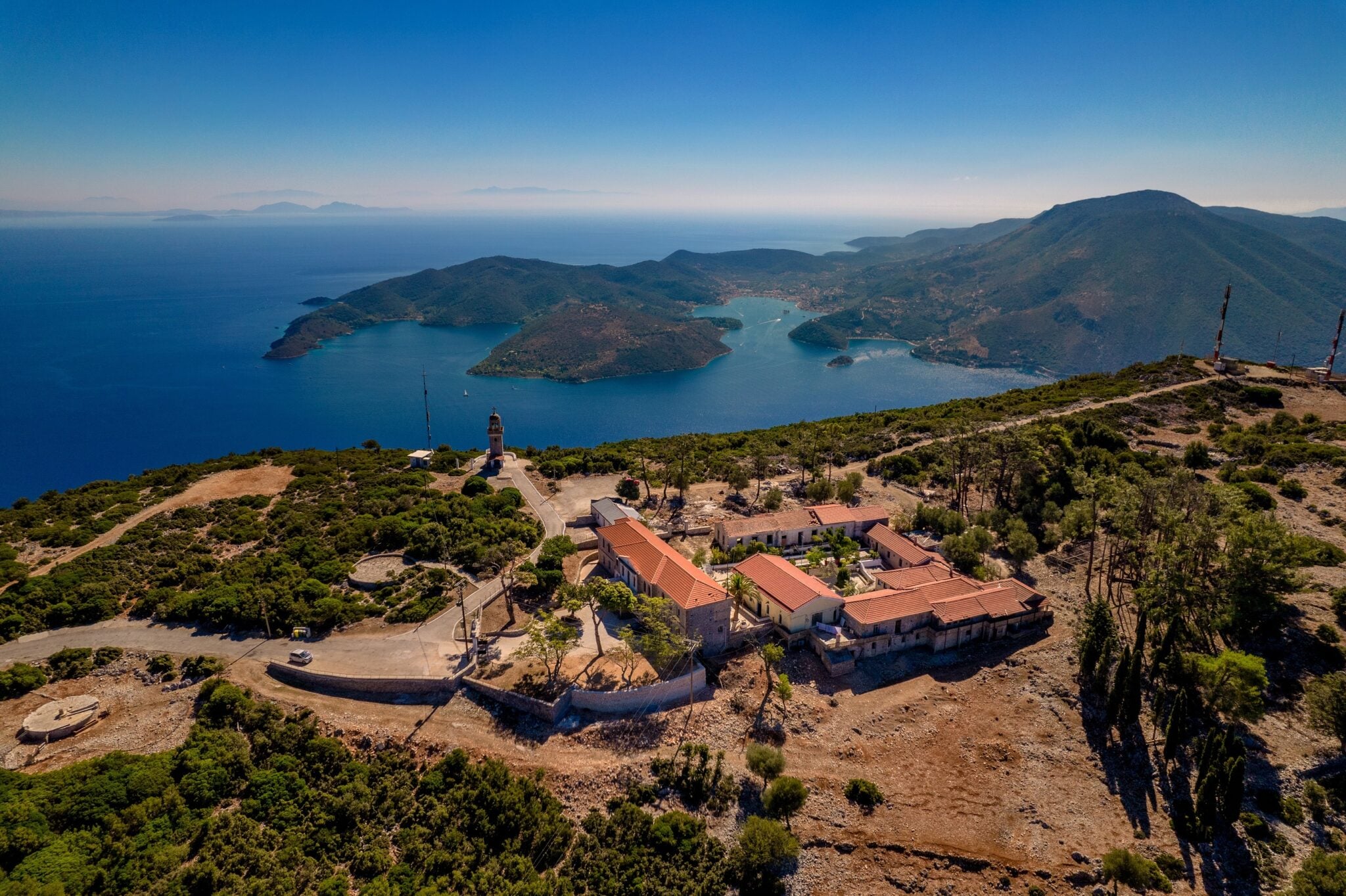
The Monastery of Panagia Kathariotissa, on the slopes of Mount Neritos at 600 metres, patron of the island
Here is the first thing to know, and it is the reason Ithaca has stayed the way it is: there is no airport on Ithaca. Every visitor arrives by sea, which is exactly as it should be for the island of Odysseus.
For UK travellers the route is straightforward. Fly to Kefalonia International Airport “Anna Pollatou” (EFL), which from roughly May to October receives direct flights from London Gatwick, London Stansted, London Heathrow, Manchester, Birmingham, Bristol, Newcastle, Leeds Bradford, Glasgow and Edinburgh with easyJet, Jet2, Ryanair, TUI and British Airways. Flying time from London is about 3 hours 30 minutes. Compare fares on Skyscanner.
From the airport it is roughly a 45 minute drive across Kefalonia to the port of Sami, from where ferries cross to Pisaetos on Ithaca in about 20 to 30 minutes, with roughly two sailings a day and more in high season. In summer there is also a crossing from Fiskardo in northern Kefalonia to Frikes. Do check ferry times against your flight before booking: connections do not always line up neatly, and an overnight in Sami or Fiskardo is sometimes the sensible answer.
Book flights at least 2 to 3 months ahead for June to September, and reserve your hire car and your ferry crossing at the same time. Ithaca is small, its car fleet is smaller still, and August sells out completely.
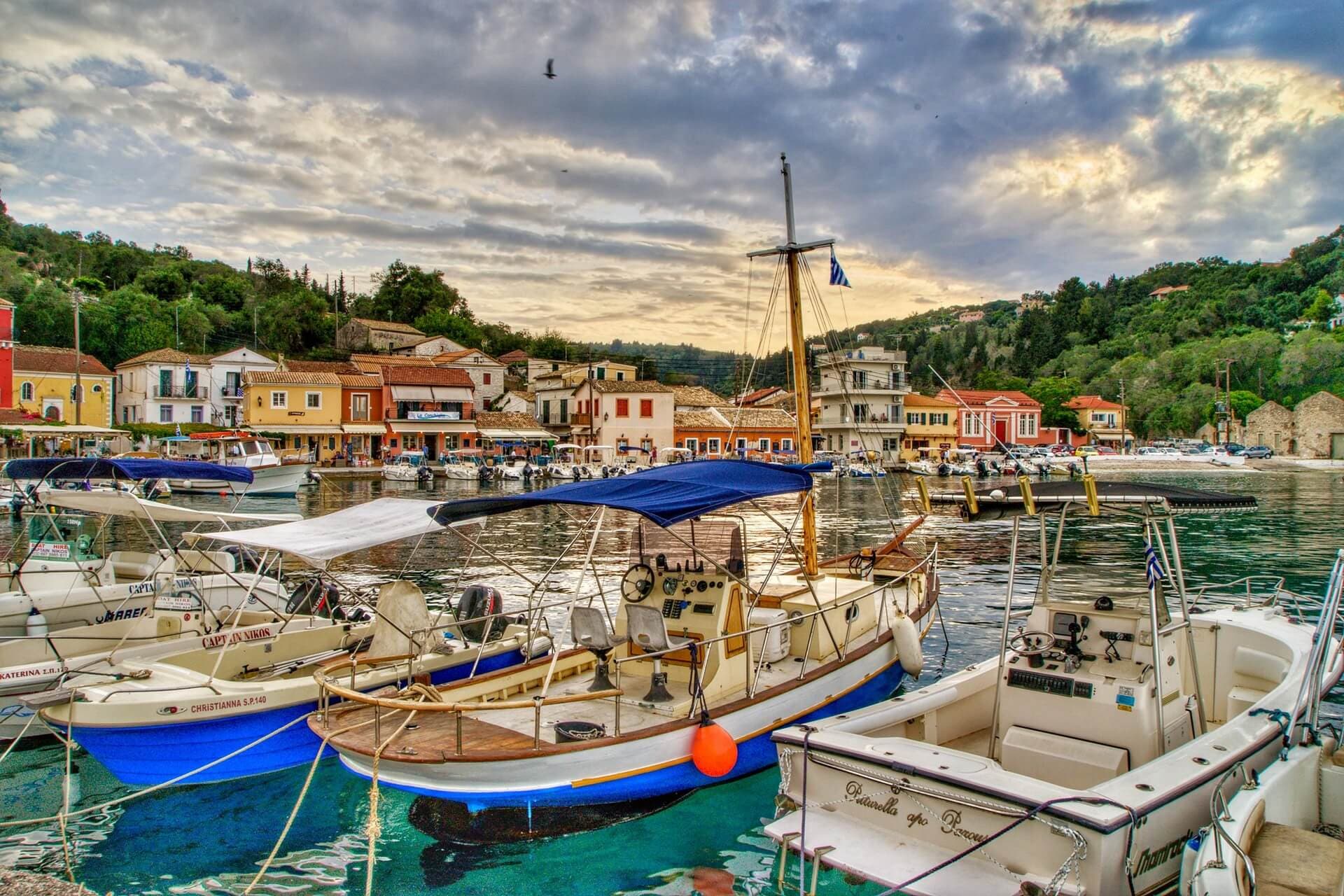
Pissaetos Port
Ithaca has the classic Ionian climate: long, hot, dependable summers and mild wet winters that leave the island greener than anything in the Aegean. Because it is narrow and mountainous, with Mount Neritos rising to 806 metres, there is almost always a breath of sea breeze somewhere, and the inland villages such as Anogi and Perachori stay noticeably cooler than the coast.
Late May and June are the pick of the year: wildflowers still out, water warm enough for long swims, everything open, and the harbours not yet full. September deserves its own mention, with the warmest sea of the entire season, softer light, and the great feast of Panagia Kathariotissa on 8 September, the island’s biggest celebration.
| Month | Avg. Temp (°C) | Sea Temp (°C) | Sunshine (hrs/day) | Crowd Level |
|---|---|---|---|---|
| April | 14–20°C | 16°C | 7 | Very Low |
| May | 17–24°C | 18°C | 9 | Low ✓ Best |
| June | 21–29°C | 22°C | 11 | Low–Medium ✓ Best |
| July | 24–32°C | 24°C | 12 | Medium–High |
| August | 24–33°C | 25°C | 11 | High – Peak Season |
| September | 21–28°C | 24°C | 9 | Low–Medium ✓ Lovely |
⚠️ Note on July & August: Ithaca never gets Mykonos crowds, but August is still August. The island fills with Greek families returning home, with yachts on the Ionian sailing circuit, and with day trippers from Kefalonia. Accommodation, hire cars and the better tavernas in Kioni and Frikes need booking well ahead. The good news is that the heat is manageable, the meltemi does not bite here as it does in the Cyclades, and a ten minute drive inland always finds you shade.
For a detailed forecast, check meteo.gr.
[IMAGE: Evening light on the Kioni waterfront with the three ruined windmills] Golden hour at Kioni
Ithaca is 27 kilometres long and shaped like two mountains joined by a thread of land, the isthmus at Aetos. That geography means every drive is a ridge road with the sea on both sides, and every village feels like a discovery. Here are the places not to miss:
Vathy: the capital, wrapped around one of the safest and most beautiful natural harbours in Greece, with the tiny islet of Lazaretto (a former quarantine station) floating in the middle of it. Low ochre and white houses, a long quay, a lively little market of side streets, and cafés that fill up at dusk.
The Archaeological Museum of Vathy: small, free of crowds and genuinely moving, with finds from Pisaetos and from the Loizos Cave at Polis Bay, spanning the Geometric to the Roman periods.
The Cave of the Nymphs (Marmarospilia): high above Dexa Bay at around 190 metres, this is where Homer has Odysseus hide the treasure given to him by the Phaeacians. Access inside is sometimes restricted, but the walk up and the view back over the bay are worth it on their own.
The School of Homer, Platrithias: the Mycenaean site below Exogi, with its rock cut stair and well, widely believed to be the palace of Odysseus. Standing there, looking north over three bays, the geography of the poem suddenly makes sense.
Monastery of Panagia Kathariotissa (Moni Katharon): perched at 600 metres on Mount Neritos, restored in 1696, home to the island’s patron icon and to the best panorama in the Ionian: Vathy below, Kefalonia to the west, the mainland mountains to the east. Its festival on 8 September is the event of the island year.
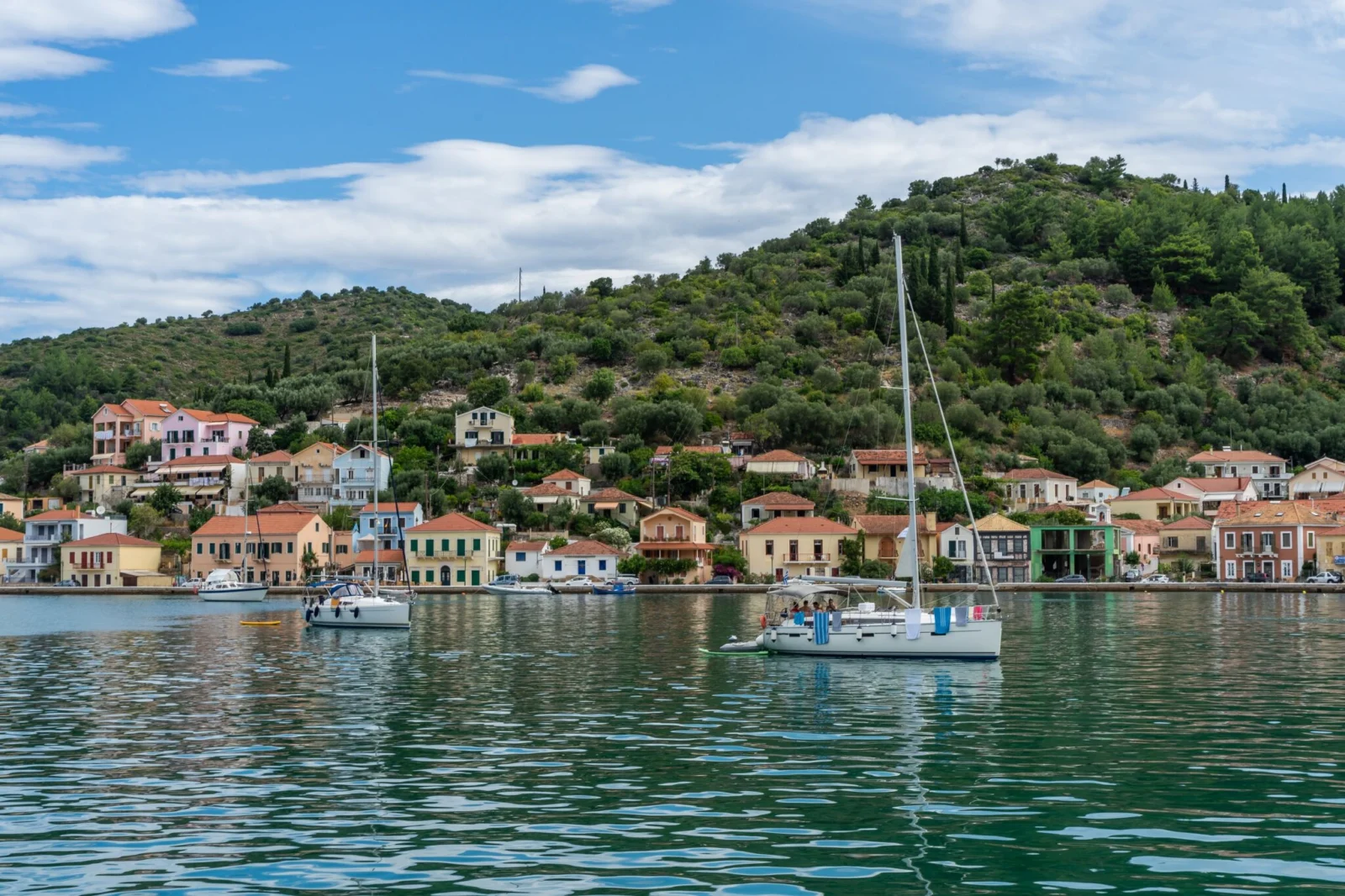
Kioni: the picture postcard village, a horseshoe of pastel houses around a yacht filled bay, with three ruined windmills standing guard at the entrance. Old mule paths climb straight out of the village into olive groves and oak woods.
Frikes: a working little fishing port between two headlands, less polished than Kioni and all the better for it, with a handful of excellent waterfront tavernas and the ferry to Lefkada.
Stavros & Pilikata Hill: the capital of the north, with a bust of Odysseus in the square, a small museum, and a hill that has been a candidate for the palace site since the 19th century.
Anogi: the old mountain capital, almost deserted now, with a Venetian bell tower, Byzantine frescoes in the church of the Dormition, and the strange standing monoliths (the “Araklis” stone) scattered in the fields around it.
Perachori: ten minutes above Vathy, a green village of vineyards and terraces with the ruins of Palaiochora, the medieval settlement, just above it. The view down over the harbour at sunset is one of Ithaca’s finest.
Exogi and the Kalamos spring: the highest village in the north, nearly abandoned, reached by a twisting road through olive groves, with sweeping views over Afales Bay.
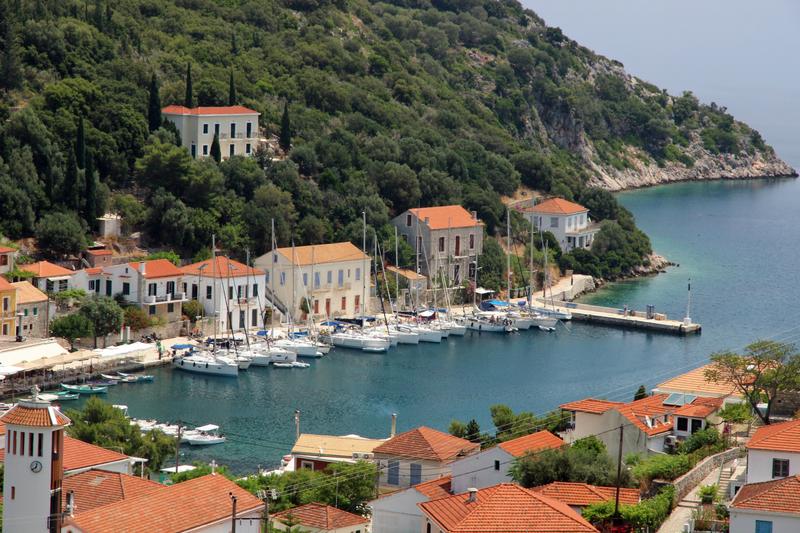
The pastel houses and yachts of Kioni harbour, Ithaca’s most photographed village
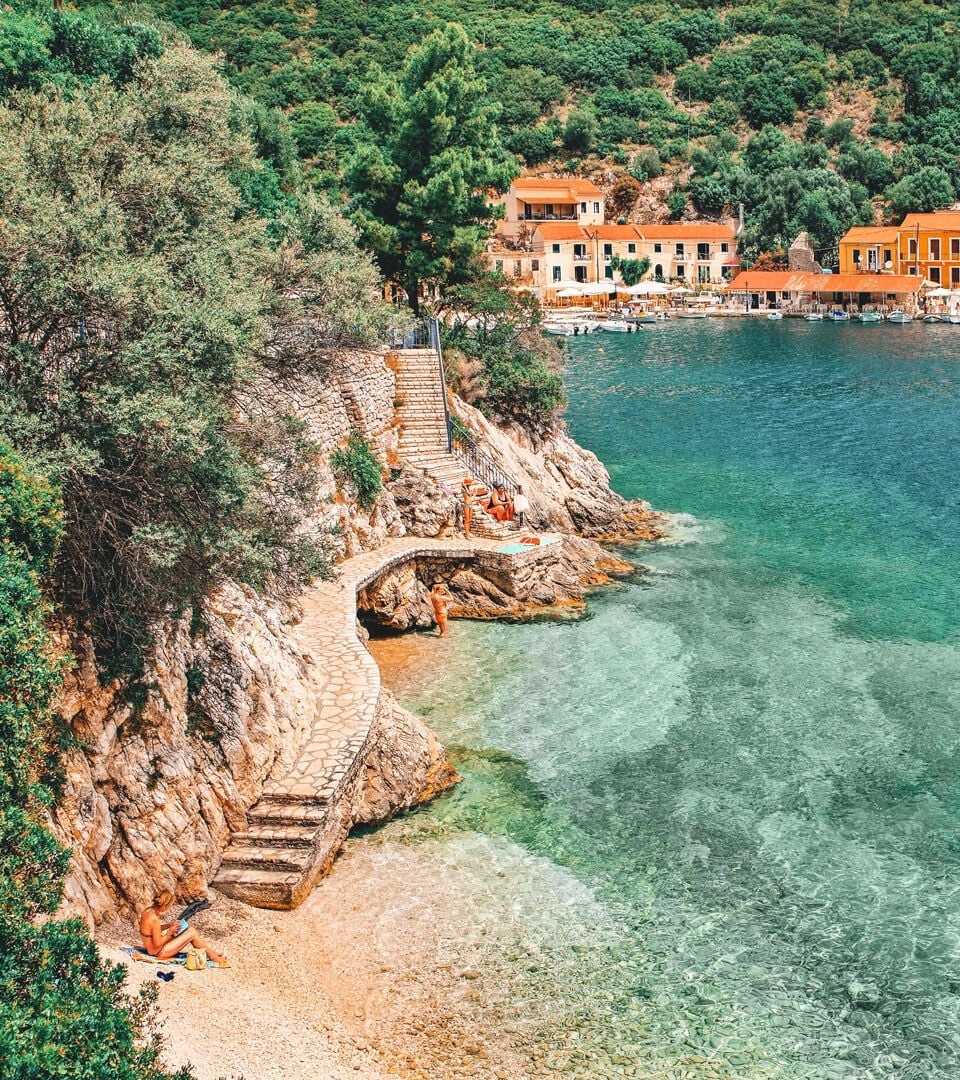
Ithaca’s beaches are white pebble rather than sand, and that is precisely why the water is so unbelievably clear. There are only one or two organised beaches on the whole island; the rest are coves where the trees come down to the waterline and you bring your own umbrella, your own lunch, and quite often your own boat. In late May and June you may have several of them entirely to yourself.
The single best investment on Ithaca is a small motorboat from Vathy, Kioni or Frikes (no licence needed for the lower powered ones). Half the coastline has no road, and that is where the island keeps its best water.
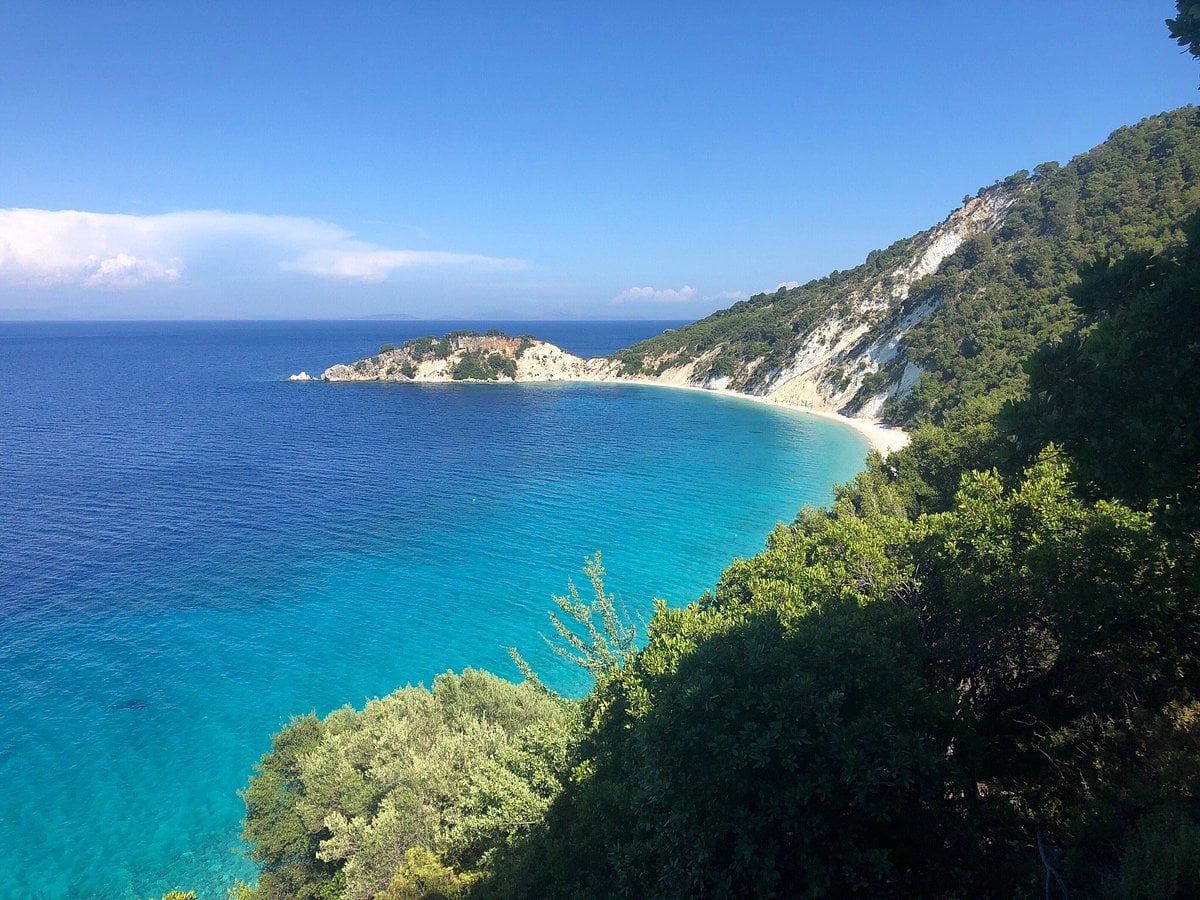
The white pebbles and turquoise water of Gidaki beach, reachable only by boat or on foot
Ithacan food is honest Ionian cooking: olive oil from the terraces, wild herbs from the hillsides, fish landed that morning, goat and rabbit from the mountain, and honey and wine that people still make at home. Portions are generous, prices are fair, and in the smaller places you may simply be invited into the kitchen to see what is cooking.
Here are some recommendations!
Kanenas – Ithaca’s highest ranked table on Tripadvisor, rated 4.7 out of 5 from more than 270 reviews, a seafood and Mediterranean kitchen run by a chef and his wife Aphrodite who greet every guest personally.
Ageri – The most reviewed restaurant on the island, 4.6 out of 5 from nearly 400 reviews, with modern takes on Greek classics, local produce and one of the best waterfront settings in the Ionian.
Yefuri – An inland institution in the north, 4.7 out of 5 from over 300 reviews, known for its garden setting, its warm welcome and a Mediterranean menu that wanders happily beyond the usual.
Chani – A much loved Greek and Mediterranean kitchen rated 4.5 out of 5 from 300 reviews, specialising in slow cooked island dishes of the sort that take all afternoon to prepare.
Myrtia Ithaca – One of the newest arrivals and already one of the best rated on the island at 4.8 out of 5, combining Greek and Mediterranean cooking with a memorable hillside view.
Kantouni – A traditional seafood and Mediterranean taverna on the Vathy waterfront, 4.3 out of 5 from more than 300 reviews, praised above all for honest cooking and generous portions.
Kohili – A long standing family favourite on the harbour, 4.3 out of 5 from over 300 reviews, reliably good value and one of the busiest tables in town on a summer evening.
Νostimon – A small, modern Greek and Mediterranean spot that regulars call the best in Frikes, rated 4.7 out of 5, ideal after a morning on the water.
Find more places to eat in Ithaca here!
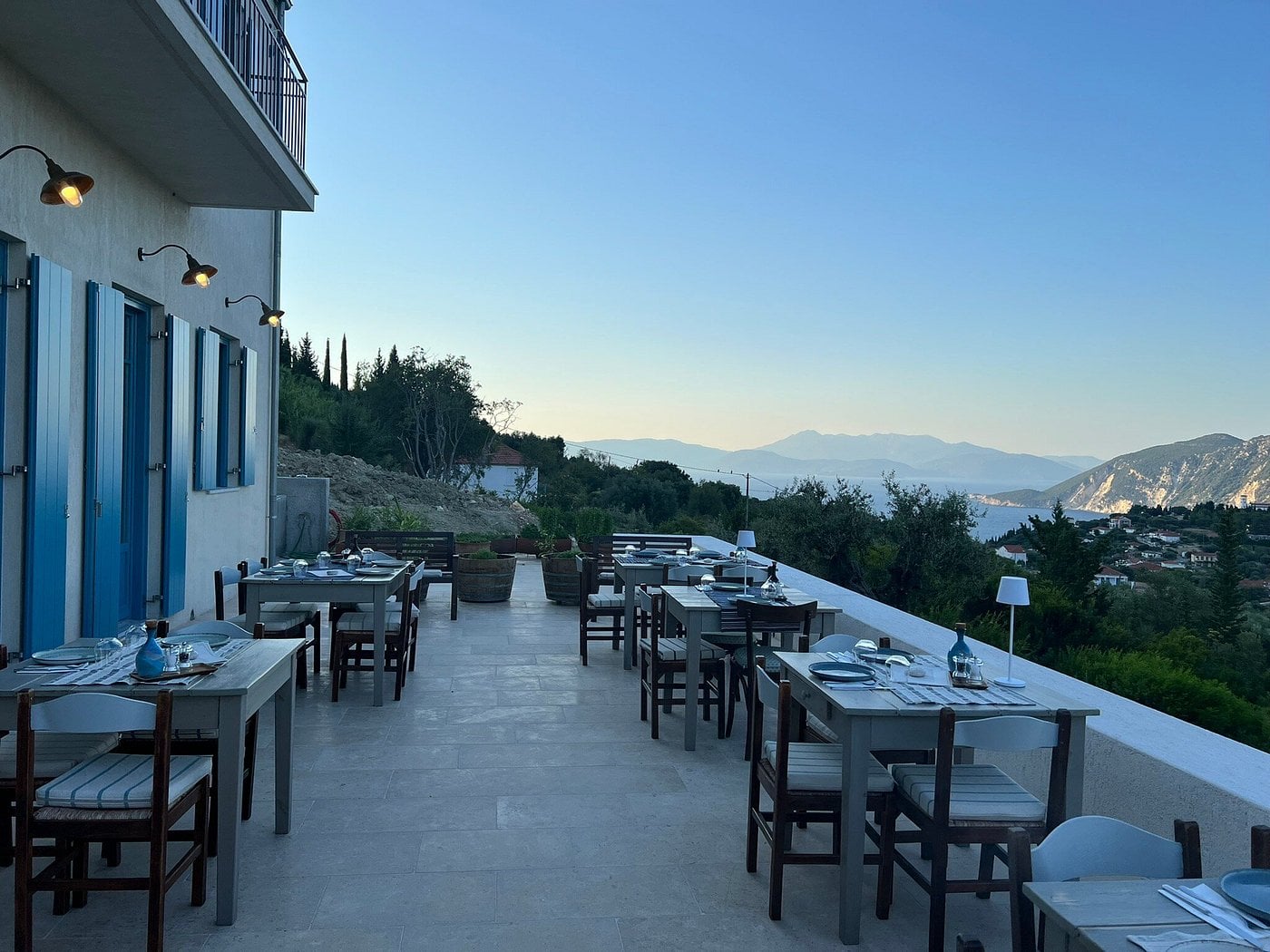
Dining at the Myrtia Restaurant with a stunning view of Ithaca
Ithaca’s kitchen is small-island cooking at its best: few ingredients, deep traditions and almost nothing wasted. Venetian influences sit alongside humble shepherds’ dishes, locally caught seafood, wild herbs, olive oil and honey. Look out for the following:
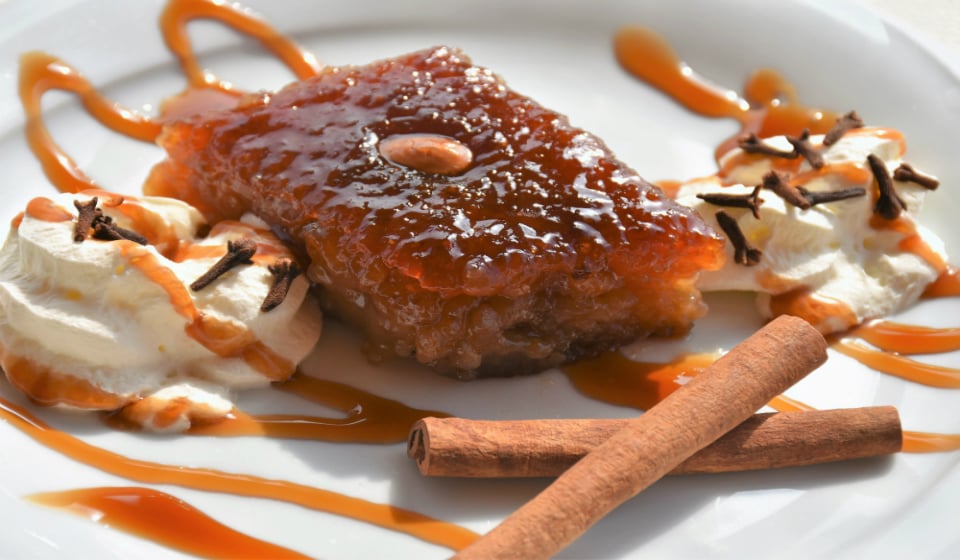
A slice of rovani, the traditional Ithacan honey cake of Ithaca
For an island of barely a hundred square kilometres, Ithaca packs in an extraordinary amount to do, almost all of it outdoors and almost none of it requiring a ticket queue. May, June and September are ideal: warm but not punishing, and the trails are at their best.
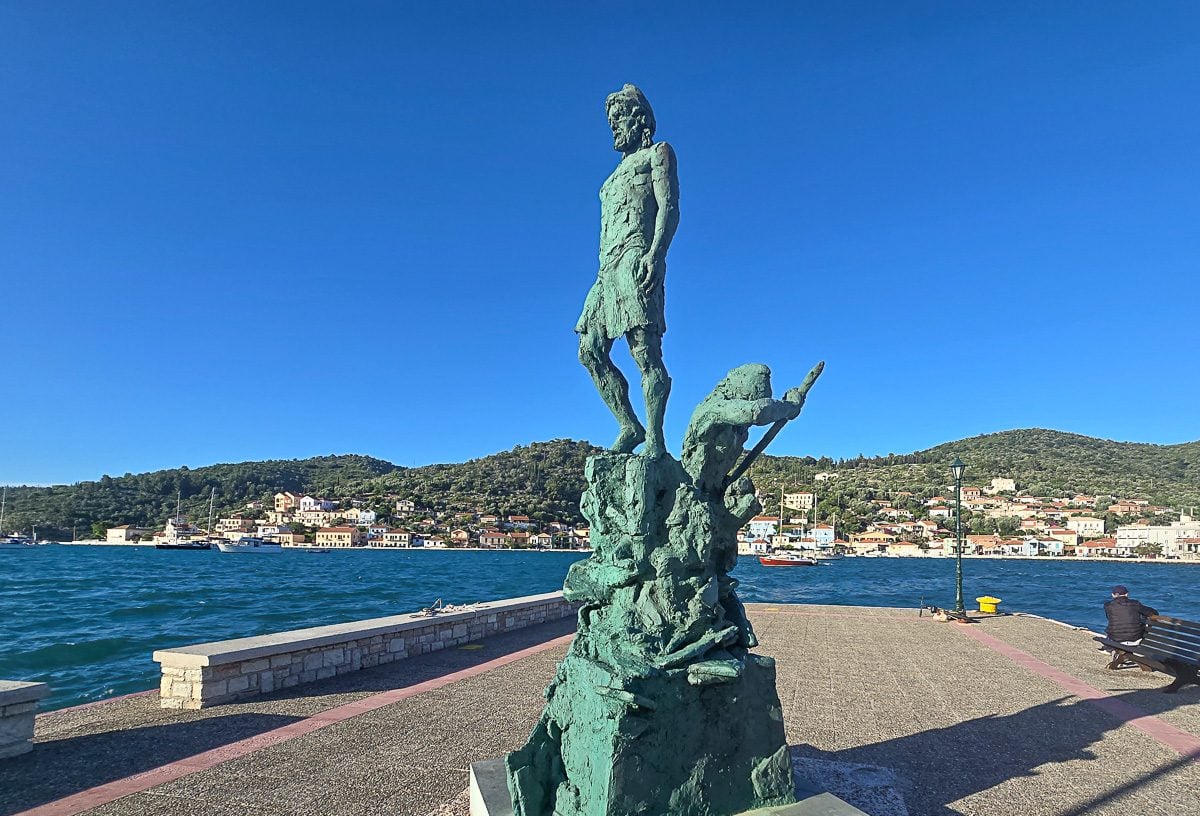
Vathy Village and the statue of legendary Odysseus
Ithaca sits in the middle of the Inner Ionian, ringed by islands and islets, and its three harbours make hopping about wonderfully easy.
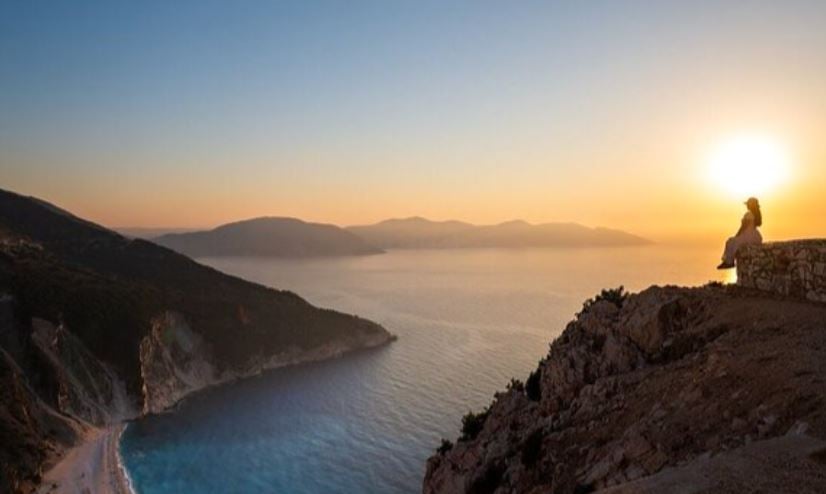
Kefalonia, another Greek mythical land, 30 minutes across from Ithaca
There are no large resort hotels on Ithaca and that is very much the point, so where you stay matters more here than almost anywhere else in Greece. This is where Ionian & Aegean Island Holidays comes in. They are a specialist British tour operator who work exclusively with Greece, with more than twenty years of experience and a portfolio of handpicked villas, apartments and small hotels rather than a catalogue of anonymous resorts. Their holidays come as complete packages with flights, transfers and car hire included, which on an island with no airport and a very small car fleet is worth a great deal.
Here are our suggestions:
Browse the full collection of villas in Ithaka and apartments in Ithaka, and don’t forget that Ionian & Aegean Island Holidays also offers fantastic properties across the rest of the Ionian Islands!
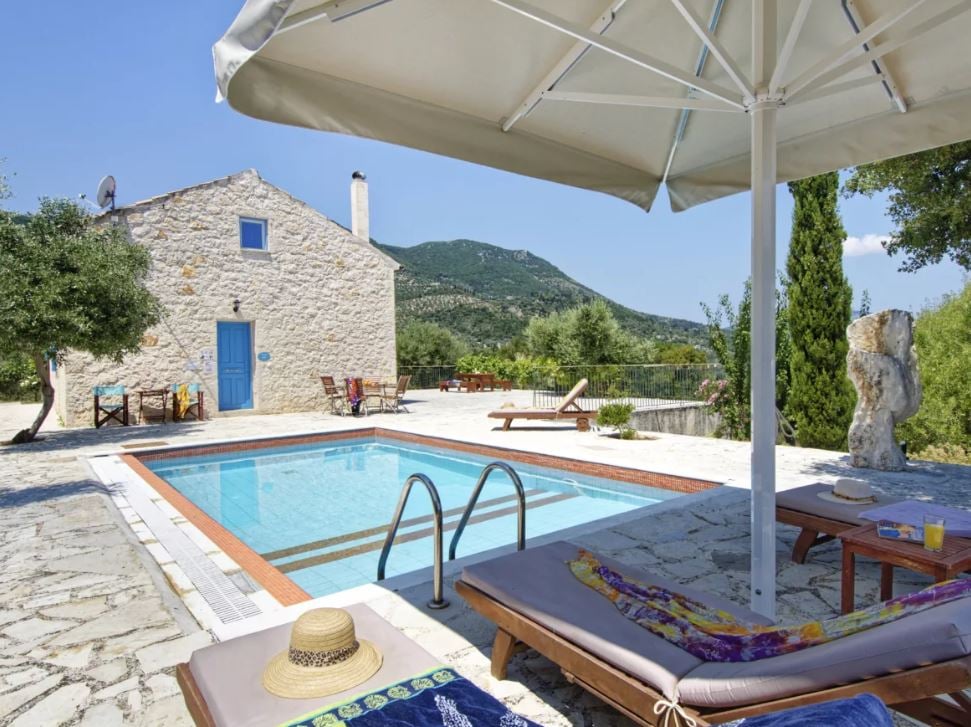
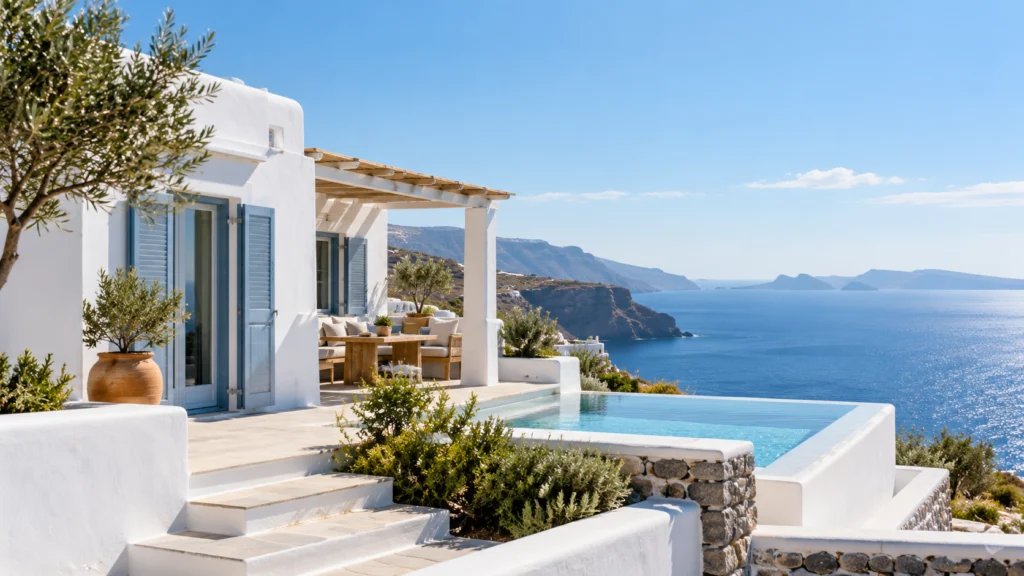
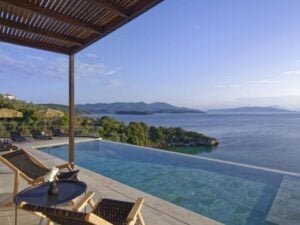
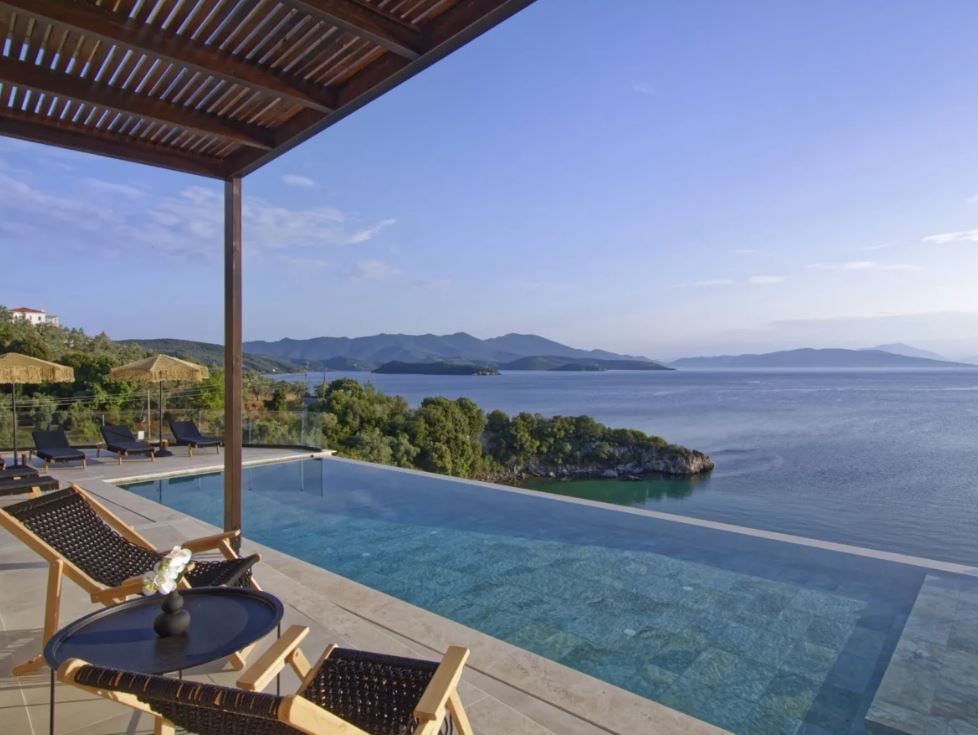
Villa Nereus, under the Greek sun of Ithaca
Ithaca is 27 km long but the roads climb, twist and switch back constantly, so distances take longer than the map suggests. Plan accordingly.
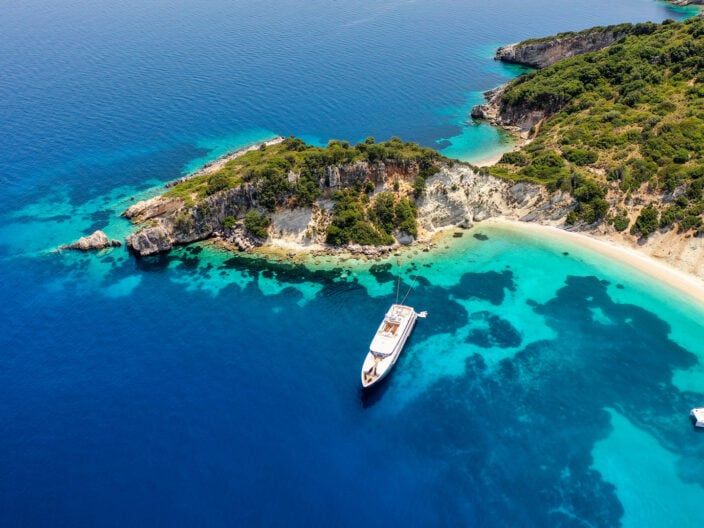
Live your own Odyssey in the mythical land of King Odysseus
Ithaca is one of the safest and friendliest islands in Greece, with a small permanent population where everybody knows everybody. A little preparation goes a long way, especially because facilities here are modest.
🚨 Emergency Numbers, Save These!:
– Police: 100
– European Emergency Number: 112
– Medical Emergency: 166
– Fire Department: 199
– Health Centre of Ithaca (Vathy): +30-26740-32222 (also listed as 26740-22222)
– Ithaca Port Authority (Vathy): +30-26740-32909
– General Hospital of Kefalonia (Argostoli): +30-2671361100
– British Embassy Athens: +30-2107272600
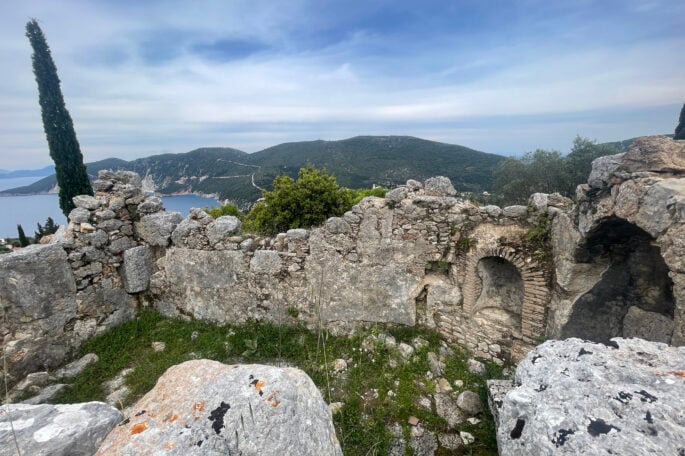
The mysterious ruins of Ithaca – Some say that this was the Palace of King Odysseus
No, and this surprises almost everyone. Nolan built his Ithaca on Favignana, a small island off western Sicily, using the Castello di Santa Caterina as the palace of Odysseus, and shot the rest of the voyage in Morocco, Iceland, Scotland and the Peloponnese. So the island on screen is a stand in. The one in the Ionian is the real thing, and you can walk into it rather than watch it.
Three sites have been in the running for over a century: Pilikata Hill above Stavros, championed by early excavators; Aetos on the isthmus, dug by the British School at Athens; and the School of Homer at Platrithias, which since the 1990s has produced the most convincing Mycenaean architecture of the three. Nothing carries a nameplate, which is exactly why standing there is so enjoyable.
Because from the mid nineteenth century onwards Ithacans left in enormous numbers, and Melbourne became the second Ithaca. The Ithacan Philanthropic Society was founded there in October 1916 and is still going, and there are far more people of Ithacan descent in Australia than there are residents on the island. In August the villages fill with returning families and you will hear broad Australian accents ordering in fluent Greek.
He did. Byron sailed over from Kefalonia on 11 August 1823, during the months he spent in the Ionian before Missolonghi, and rode across the island to Stavros and the northern sites. He was, by all accounts, deeply taken with it.
Yes. Upstate New York was mapped out in the early 1800s by surveyors with a taste for the classics, which is why Ithaca sits near Ulysses, Syracuse and Troy. Cornell students have been living with the joke ever since.
Sometimes. Access to the interior has been restricted on and off for years because of rockfall, so check locally before you climb up. The walk itself and the view back down over Dexa Bay justify the trip either way.
The island’s biggest day. The feast of Panagia Kathariotissa brings islanders and returning emigrants up the mountain to the monastery at 600 metres for the liturgy, then down to eat, drink and dance late into the night. If your holiday can be timed around one date, make it this one.
Because vathy means “deep” in Greek, and the town sits at the head of a long, deep, almost landlocked inlet. Several Greek islands have a Vathy for exactly the same reason, which is why you should specify “Vathy, Ithaca” when booking anything.
Not in the club sense, and nobody comes here for that. What there is: harbour bars in Vathy and Kioni that stay open as long as people are sitting, a handful of music nights in summer, village festivals with live rebetiko, and the reliable Greek habit of dinner starting at ten.
Sea urchins yes, on rocky entries, which is the main practical argument for water shoes. Jellyfish appear occasionally in late summer as they do everywhere in the Ionian, but they are not a regular problem on Ithaca’s sheltered east coast.
No, and locals will gently correct you. Ithaca is its own municipality within the Ionian Islands region, with its own mayor, its own port authority and a fierce sense of separateness from its much larger neighbour, despite depending on it for the airport.
In July and August, absolutely. Vehicle space on the Kefalonia and Astakos crossings is limited and sells out, especially around the 15 August holiday. Foot passengers can usually turn up, but with a car, book.
You can, and it is beautiful in a completely different way: green, wet, wild and very quiet. But most tavernas, hire firms and accommodation close from November to March, ferry sailings are reduced, and a bad blow can cancel them altogether. It is a trip for the curious rather than the casual.
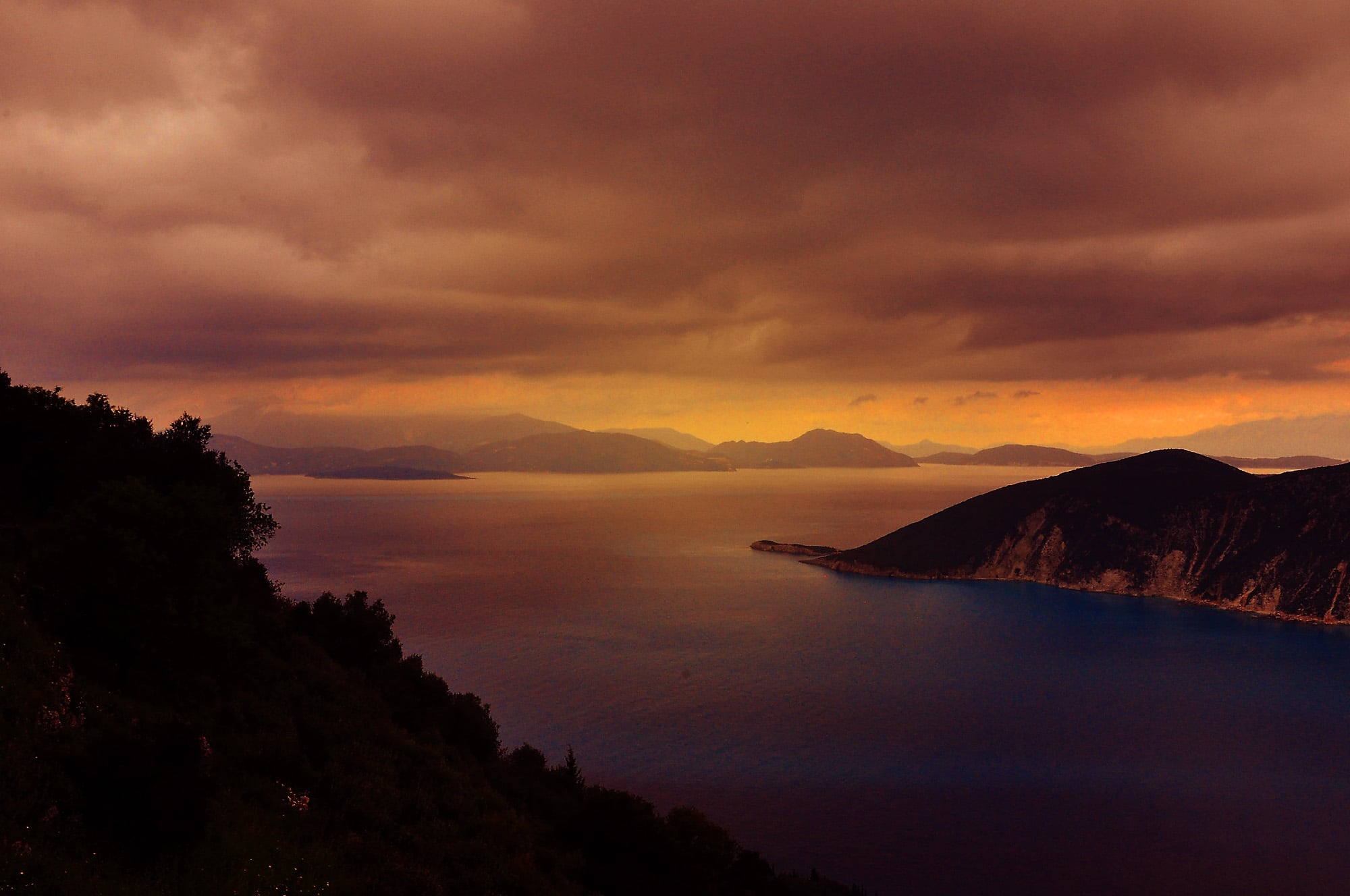
Sunset over Afales Bay in northern Ithaca
Ithaca does not overwhelm you. It works on you slowly, over a few days, until you find yourself planning the next visit before this one has ended. Whether you come for Homer, for the water, for the walking, for the food, or simply because the name has been in your head since school, this small green island in the Inner Ionian has a way of keeping people. Slow down, take the boat out, eat late, climb to the monastery once at dawn, and let the island set the pace. From your first sight of Vathy’s horseshoe harbour to your last swim before the ferry, Ithaca is not so much a holiday as an arrival. Safe travels, and καλό ταξίδι (kaló taxídi): may the road to Ithaca be long, and may this be the first of many.
Ithaca, the journey and the destination!