

Nafplio is Greece’s most romantic small city — a layered jewel of Venetian fortresses, neoclassical mansions, and cobblestone lanes that tumbles gracefully into the sparkling waters of the Argolic Gulf.
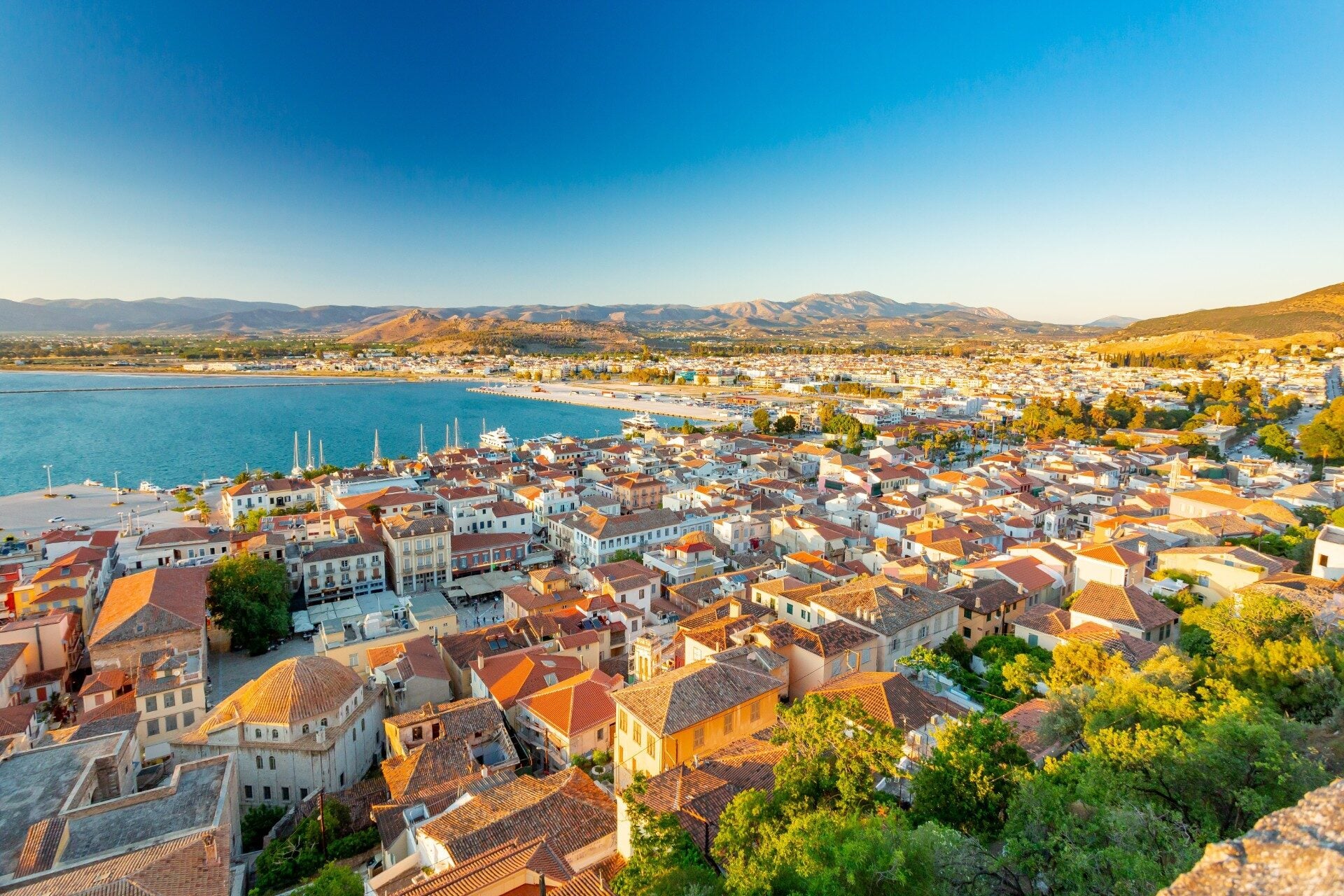
Nafplio arrives quietly, without the grand ruins or island glamour often associated with Greece, yet history is everywhere: in its stone streets, Venetian mansions, shuttered windows, and the small island fortress guarding the harbour. Set on a narrow peninsula in the northeastern Peloponnese, between mountains and the Argolic Gulf, it feels distinct from the moment you enter the old town.
After the War of Independence, Nafplio became the first capital of modern Greece, from 1823 to 1834. Its traces remain in Syntagma Square, in the building that housed the first parliament, in the church where the first governor was assassinated, and above all in Palamidi, the dramatic fortress rising over the city.
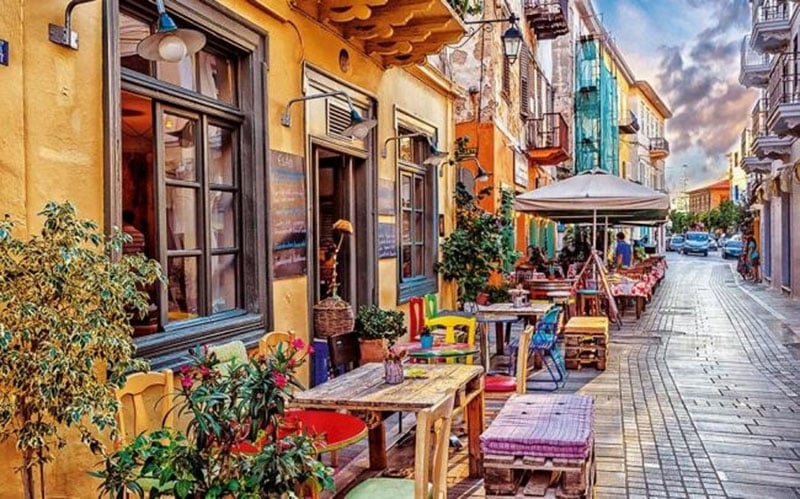
What makes Nafplio special is how intact it remains. Its Venetian, Ottoman, and neoclassical architecture has survived without turning the town into a museum. Locals still gather in the squares, shop at the weekly markets, and walk the waterfront promenade at sunset.
Come here expecting Santorini’s drama or Mykonos’s glamour and you will miss the point entirely. Come expecting something quieter, deeper, and more genuinely Greek — a city where the best experience of all is simply to wander — and Nafplio will reward you beyond all measure.
The first capital of modern Greece, the most romantic city in the Peloponnese, and one of the most beautiful small towns in all of Europe — Nafplio awaits.
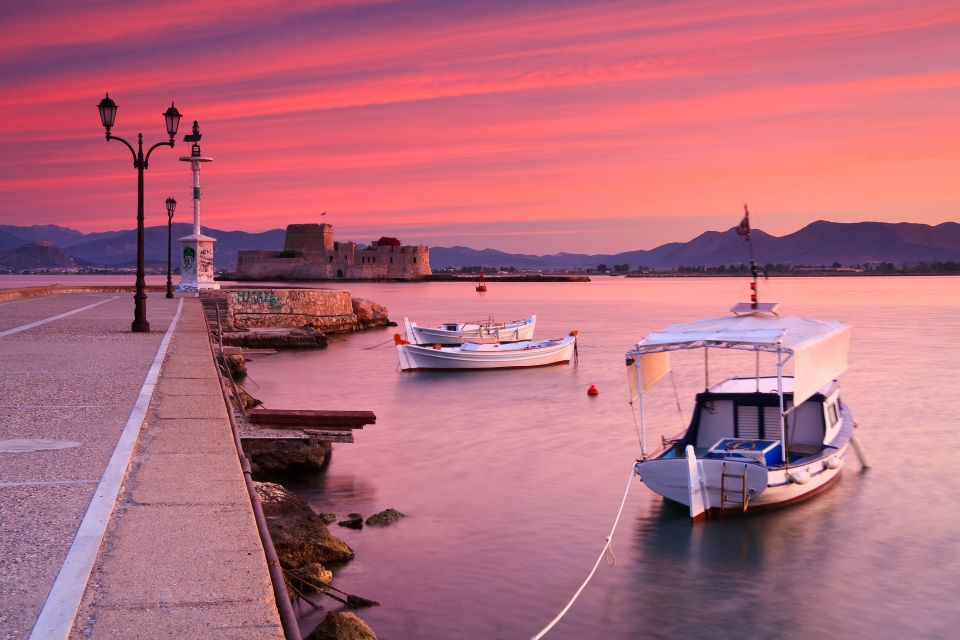
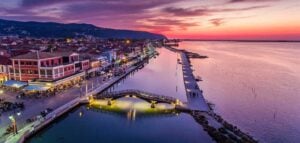
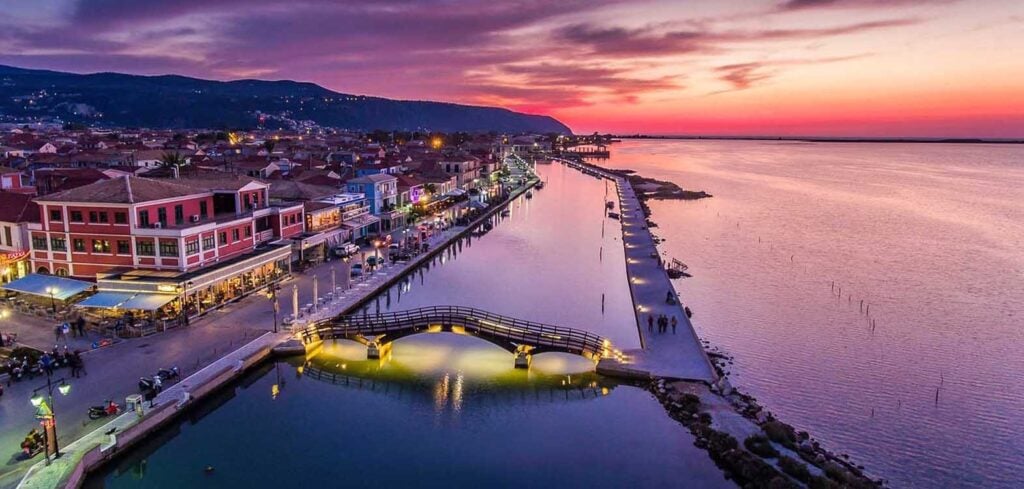
Sunset in the Port of Nafplio
The story of Nafplio begins with myth: according to legend, it was founded by Nafplius, son of Poseidon and the nymph Amymone. In antiquity, it served as the port of Argos, though its fortunes declined after it sided with Sparta and was destroyed by the Argives. By the Roman period, Pausanias found it deserted, but the city rose again in the medieval era, when the Byzantines fortified Acronafplia and turned it into a strategic stronghold.
Nafplio’s defining character came under Venice. From 1388, the Venetians expanded the lower town, strengthened its walls, and built Bourtzi, the small island fortress in the harbour. After periods of Ottoman and Venetian rule, they also constructed Palamidi, the vast hilltop fortress completed in 1714. The Ottomans retook the city in 1715, and Nafplio remained under their control until the Greek War of Independence.
In 1822, after a long siege, Nafplio surrendered to Greek forces and soon became the first capital of modern Greece. The Vouleftikon housed the first Hellenic Parliament, Ioannis Kapodistrias governed from here before his assassination in 1831, and King Otto arrived soon after before moving the capital to Athens in 1834. Today, Nafplio is one of Greece’s most beautifully preserved historic towns, its survival due in part to the work of archaeologist Evangelia Protonotariou-Deilaki.
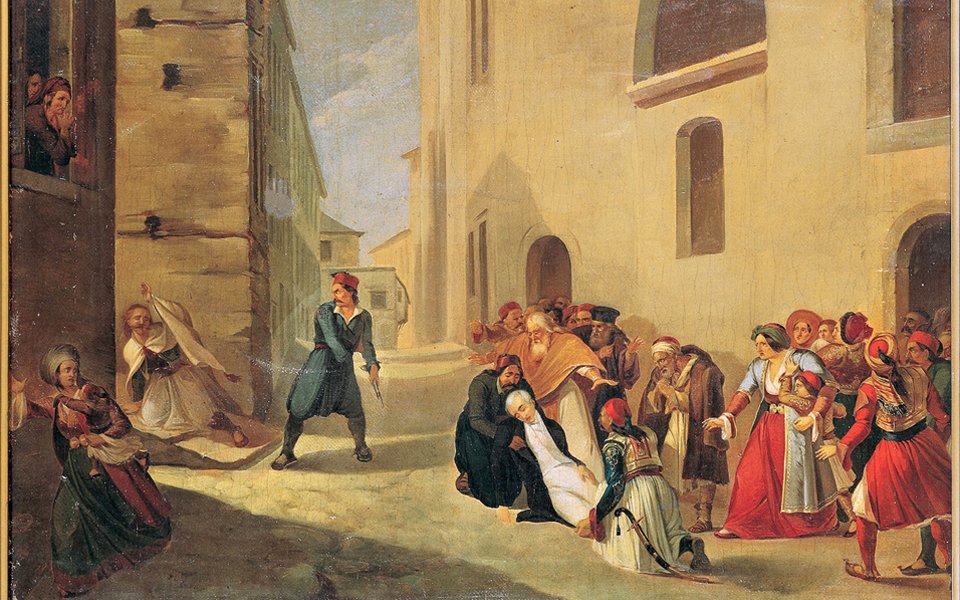
The assassination of Ioannis Kapodistrias, 27th September 1831
Nafplio has no airport of its own, but reaching it from the UK is very straightforward — and the journey from Athens, once you arrive, is one of the most scenic drives in Greece.
By Air to Athens, then overland:
The main route for UK travellers is to fly into Athens Eleftherios Venizelos International Airport (ATH), then travel south to Nafplio. Direct flights from London operate year-round with British Airways, easyJet, and Ryanair, departing from Heathrow, Gatwick, Luton, and Stansted respectively. Flight time is approximately 3.5 hours. From other UK cities, connecting flights via Athens are widely available. Book 6–8 weeks in advance for the best prices, particularly for summer travel.
From Athens Airport to Nafplio:
Practical tip: If arriving at Athens Airport in the morning, consider driving directly to Mycenae or Epidaurus en route to Nafplio — both sites are on or near the road south, and this allows you to hit the major day-trip destinations before you’ve even checked in.
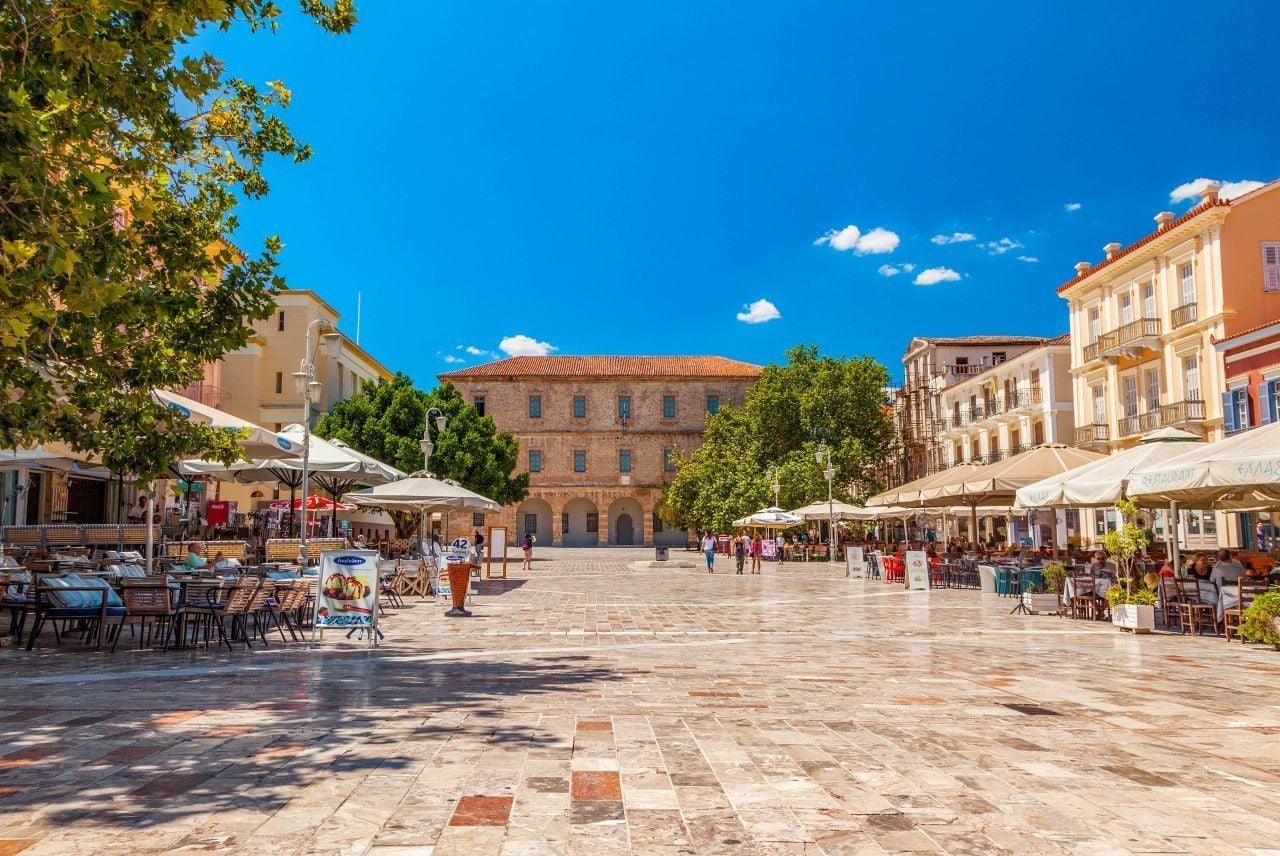
Syntagma Square in Nafplio
Nafplio enjoys a classic Mediterranean climate — hot, dry summers, mild and occasionally rainy winters, and glorious shoulder seasons in spring and autumn. The city’s position on the eastern Peloponnese gives it reliable sunshine throughout much of the year, and it is one of the warmest spots in the mainland even in winter.
| Month | Avg Temp (°C) | Rainfall | Sunshine
(hrs/day) |
Crowd
Level |
|---|---|---|---|---|
| January | 10 | Moderate | 4 | Very Low |
| February | 11 | Moderate | 5 | Very Low |
| March | 14 | Light | 6 | Low |
| April | 18 | Light | 8 | Low-Medium |
| May | 22 | Very Light | 10 | Medium ✓ |
| June | 27 | Rare | 12 | Medium-High ✓ |
| July | 30 | Negligible | 13 | High |
| August | 30 | Negligible | 13 | Very High |
| September | 26 | Very Light | 11 | Medium-High |
| October | 21 | Light | 8 | Medium ✓ |
| November | 16 | Moderate | 5 | Low |
| December | 12 | Moderate | 4 | Very Low |
Check the weather in Nafplio here!
May is, without question, the finest month to visit Nafplio. The landscape of the Argolida is at its most vivid — wildflowers carpeting the hillsides, the almond and citrus groves in fruit, the Argolic Gulf a shimmering, inviting blue. Temperatures are perfect for both sightseeing and swimming, crowds are manageable, and the ancient sites of Mycenae and Epidaurus can be explored in genuine peace.
June and early October run a very close second — warm enough for the beach, cool enough for the 999 steps up to Palamidi, and with the long golden light that makes the old town look its most magnificent at dusk. July and August are intensely hot and very popular with Greek weekenders from Athens; Nafplio can feel crowded, and prices at hotels peak.
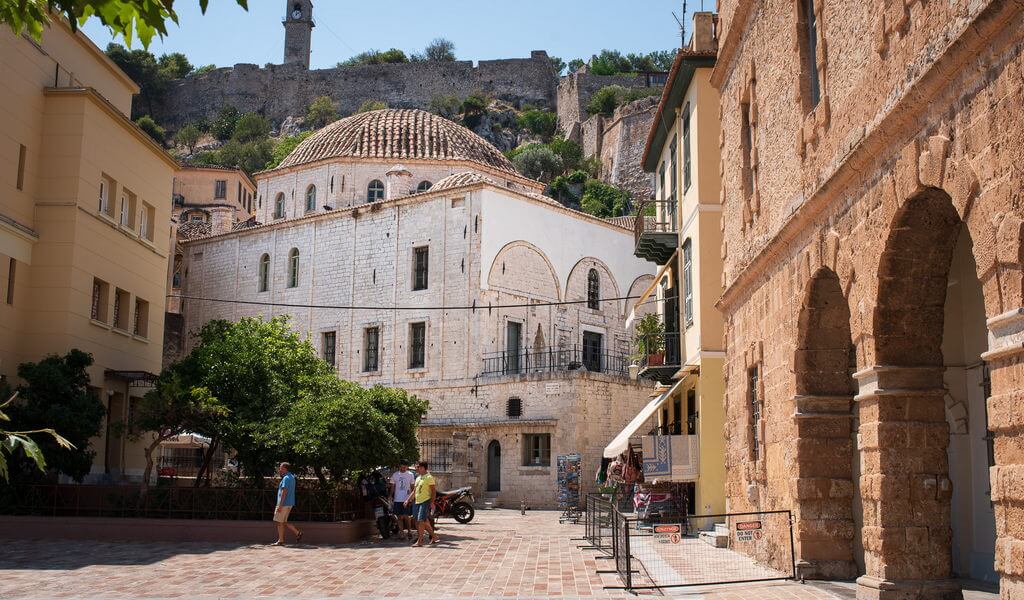
The Vouleftikon (1st Peoples Assembly of Greece)
Palamidi Fortress: This is Nafplio’s great monument — a vast, multi-bastion Venetian fortress completed in 1714 and perched 216 metres above the sea on the rocky hill north of the old town. The climb up the famous 999 steps (the actual count varies, but it is formidable) is demanding and wonderful, rewarding you with panoramic views over the Argolic Gulf, the old town’s terracotta rooftops, and the mountains of the Peloponnese. Give yourself at least two hours. The fortress opens daily and admission is around €8. Go early in summer — the climb in midday heat is genuinely punishing.
Bourtzi Castle: Sitting on its tiny island in the centre of the harbour, Bourtzi is one of the most photographed sights in all of Greece — and it earns the attention. Built initially in 1471 and substantially expanded by the Venetians in the 17th century, it served at various points as a prison, a home for the town’s executioners, and briefly as a luxury hotel. Small boats make the 10-minute crossing from the harbour throughout the day, and in summer the island hosts a programme of cultural events. Simply watching it from the waterfront at dusk — lit gold against the darkening water — is one of the essential Nafplio experiences.
Acronafplia: The oldest fortified part of Nafplio, the finger-shaped promontory that juts into the sea south of the harbour carries on its heights the remains of three successive fortifications — Byzantine to the west, Frankish to the east, and the Venetian Castello di Toro to the northwest. The path that winds around the base of its cliffs to Arvanitia Beach is one of the most beautiful short walks in Greece, combining sea-level views of the Argolic Gulf with the drama of the ancient walls above.
Syntagma Square: The heart of Nafplio’s old town, Syntagma is one of the most historically charged public spaces in Greece. On its edges stand the Archaeological Museum (housed in a grand Venetian building), the Vouleftikon — the former mosque that became Greece’s first parliament — and the church of Agios Georgios, where King Otto was crowned. The square is perfect at any time of day, but particularly in the late evening, when the café tables fill and the floodlit buildings glow amber.
Archaeological Museum of Nafplion: Housed in a beautiful 18th-century Venetian building on Syntagma Square, this is one of the finest regional museums in Greece. Its collection focuses on the Mycenaean civilisation that dominated the Argolida from around 1750 to 1050 BCE — including bronze armour, pottery, seals, and stunning grave goods from the surrounding sites. The famous Dendra Panoply — a near-complete bronze suit of armour dating to around 1450 BCE, one of the oldest in the world — is among the most extraordinary objects you will see in any museum anywhere.
Church of Saint Spyridon: A small, deeply atmospheric church tucked into the alleyways of the old town, Saint Spyridon is famous — or infamous — as the site of the assassination of Ioannis Kapodistrias on 9 October 1831. The bullet hole in the doorframe, still clearly visible, is one of those rare moments when history reaches out and physically touches you. The church itself is beautiful, with an elaborate carved wooden iconostasis.
Nauplion Promenade: The waterfront promenade that curves around the harbour from the old town to the Arvanitia coastal path is the living room of Nafplio. Walk it at sunset, when the light turns the fortress walls to honey and the Bourtzi floats on a sea of gold, and you will understand instantly why the Venetians once called this city the Naples of the East. The evening volta — the traditional Greek evening promenade — is alive and well here.
Tiryns: Just 5 kilometres outside of town stands one of the most remarkable — and under-visited — Bronze Age sites in Europe. Tiryns was a major Mycenaean palace city, fortified with so-called Cyclopean walls — massive limestone boulders, some weighing 14 tonnes — that the later Greeks believed could only have been built by a race of giants. Homer praised it. Heracles was, mythologically, born here. The site sees a fraction of Mycenae’s crowds, and the close-up experience of those prehistoric walls is, in its way, more viscerally overwhelming.
Vouleftikon: The most historically loaded single building in Nafplio: an Ottoman mosque built in 1730, converted into Greece’s first parliament building in 1825, and now home to the Municipal Gallery of the city. The legend of its construction — an Ottoman Aga commissioning it as penance for the murder of two young Venetian brothers who held a treasure map — is almost certainly apocryphal, but the building itself is magnificent, a domed grey stone chamber of solemn dignity.
Basil Papantoniou Foundation: Housed near the old town, this thoughtful cultural institution combines a museum of modern Greek costume and folk art with rotating exhibitions on Greek heritage and culture. The collection of traditional dress from different regions and centuries is extraordinary — and the building itself, a neoclassical gem, is worth the visit.
Folklore Museum of Peloponnese: One of Nafplio’s most rewarding small museums, the Folklore Museum — closely associated with the Basil Papantoniou Foundation — opens a vivid window onto the everyday life, dress, craft, and domestic culture of the Peloponnese. Its collections bring together traditional costumes, textiles, jewellery, musical instruments, engravings, household objects, and tools, creating a richly human counterpoint to the town’s fortresses and grand political history..
National Gallery – Nafplion Annex: Housed in a handsome neoclassical building ceded by the Municipality of Nafplio and inaugurated in 2004, the Nafplion Annex of the National Gallery gives the old capital a fitting artistic anchor. Its exhibitions focus strongly on modern Greek art and the imagery of national identity, independence, and historical memory — subjects that feel especially powerful in a city so closely tied to the early years of the Greek state.
The Land Gate: Standing beneath the walls of Acronafplia, the Land Gate was once the formal entrance into fortified Nafplio — the point where the world outside ended and the protected Venetian city began. Built in its present form in the early 18th century, it replaced an earlier gate and was approached by a wooden drawbridge over a seawater moat; after sunset, the gate was closed, and anyone left outside had to spend the night beyond the walls.
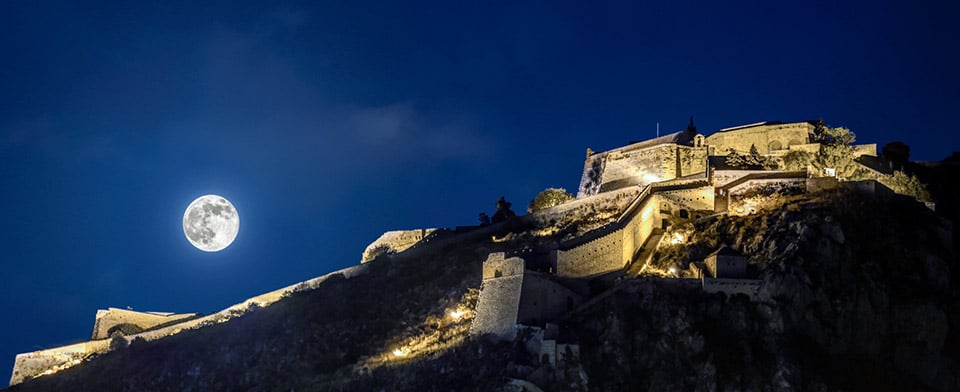
Palamidi Fortress
The Argolida — the region of which Nafplio is the capital — is one of the most remarkable food-producing areas in Greece. The coastal plains are orange country: Nafplio oranges are famous throughout Greece for their sweetness, and the scent of citrus groves perfumes the roads south and west of the city. The hills produce artichokes, olives, and almonds; the sea provides squid, sea bream, and sea bass; and the pastoral tradition of the Peloponnese gives you slow-cooked meats of a quality rarely found in the cities. Nafplio eats exceptionally well.
Nafplio and the wider Argolida reward the hungry traveller with elemental Peloponnesian cooking, village traditions, and pastries worth planning a morning around. Here are the best local dishes!
Portokalopita (Orange Pie): A regional speciality that appears in its best form in the local bakeries and pastry shops — a flaky pastry filled with candied orange peel and cream, utterly specific to this corner of Greece and deeply good.
Gkiosa: The great slow-cooked meat dish of the Argolida — an elder ewe or goat sealed in a clay-stoppered stone oven and left to its own devices for hours. The result is falling-apart tender, intensely flavoured, and deeply ancient in character. Ask for it in the more traditional tavernas.
Gogkes: Handmade pasta — a local tradition specific to the villages of the Argolida — typically served with grated gruyere from the village of Trachia or crumbled Argos feta. Simple, delicious, and almost impossible to find outside the region.
Artichoke dishes: The Argolida is artichoke country, and local cooks have devised an extraordinary range of preparations — artichoke meatballs, artichoke au gratin, artichoke soufflé, artichoke ala polita with lemon and dill. Order them at every opportunity.
Goat Bogana: A traditional stew of the Argolida — slow-braised goat in a rich, herbed sauce — that appears on the menus of the more old-fashioned tavernas and represents the cooking of the Peloponnese at its most elemental and satisfying.
Gournopoula: A famous traditional dish of Argolis: young pork slow-roasted in the oven until tender. It is especially loved for its crispy skin and melt-in-your-mouth meat.
Bougatsa: The flaky custard-filled pastry that is the Greek breakfast of champions. The bakeries of Nafplio do it well — grab one with a strong Greek coffee at a café on Syntagma Square and you will be fortified for whatever the day demands.
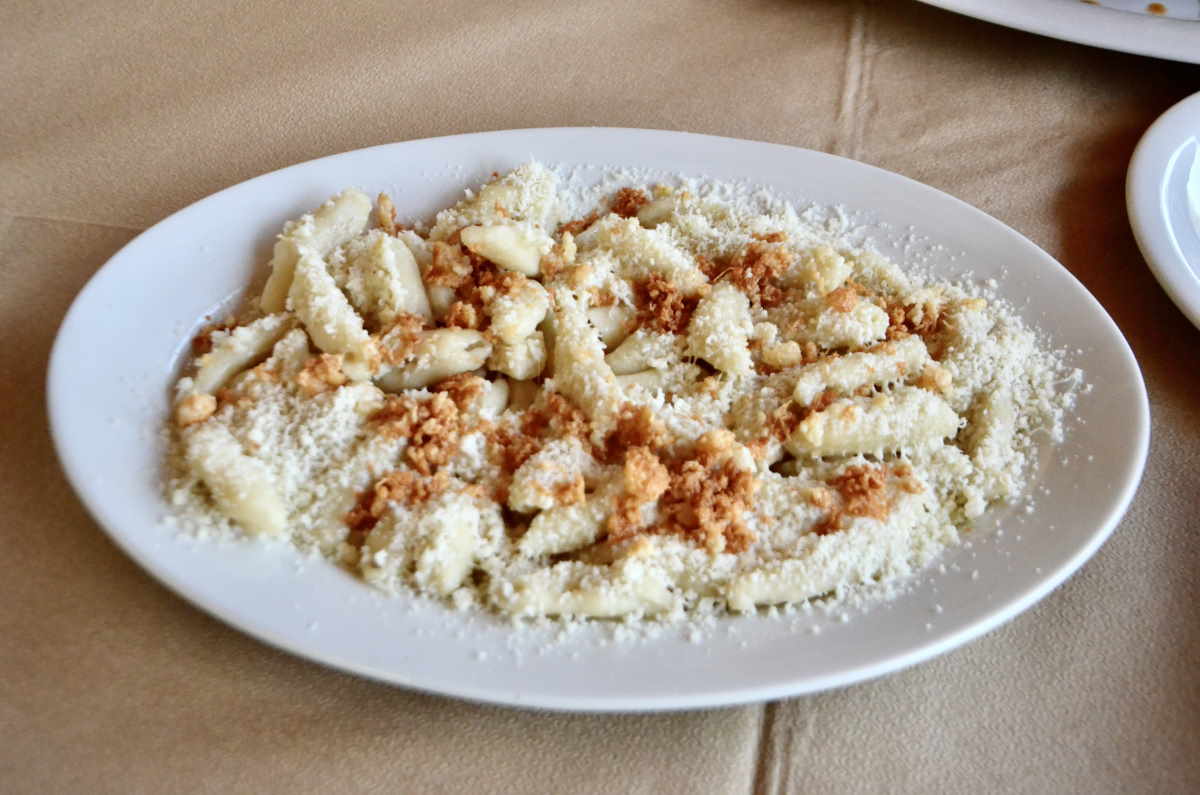
Gkogkes Pasta
Nafplio’s best tables lean into Greek and Mediterranean cooking: grilled meats, seafood, village recipes, local pasta, and generous taverna-style hospitality. Here are our suggestions!
Pidálio Restaurant — A refined Greek-Mediterranean restaurant with a modern touch, ideal for a more polished dinner in Nafplio.
Kastro Karima — A warm, traditional taverna serving generous Greek dishes with an old-town atmosphere.
Stávlos Náfplio — A strong choice for grilled meats, local flavours, and hearty Greek comfort food.
Taverna Psalidas — A classic village-style taverna just outside Nafplio, known for honest, traditional cooking.
Menta — A cosy Greek-Mediterranean spot with well-prepared local dishes and a relaxed, contemporary feel.
Kellari — A good option for seafood, meze, and Mediterranean plates in a simple, welcoming setting.
Gastronoulis Taverné — A traditional taverna-style restaurant where local pasta, lamb, and rustic Peloponnesian flavours stand out.
Aiolos Tavern — A long-standing Nafplio favourite for Greek classics, fresh ingredients, and easygoing dining.
Vyzantio — A reliable old-town restaurant for traditional Greek dishes in a charming, central setting.
Alaloum — A casual seafood and Mediterranean restaurant, well suited for fish, meze, and relaxed local dining.
For more restaurants in Nafplio, check here!
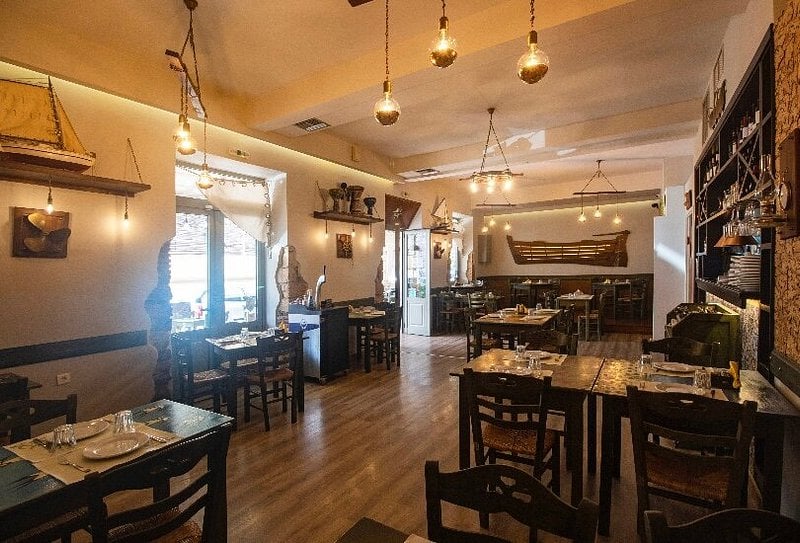
Pidalio Restaurant
Climbing Palamidi Fortress: The 999 steps up from the old town to the fortress is, for many visitors, the physical highlight of the trip — a genuine climb (allow 30–40 minutes up, less coming down) that rewards with the most extraordinary views in the Peloponnese. Go early morning in summer; take water, wear good shoes, and pace yourself. The alternative is to drive up and enter from the landward side, but walking up is the real experience.
Kayaking to Bourtzi: Several operators in Nafplio offer sea-kayaking tours of the harbour, including a paddle out to the island fortress of Bourtzi — a wonderful way to appreciate both the town’s skyline and the strategic genius of its medieval defences. Tours typically last 2–3 hours and no experience is necessary.
The Arvanitia Coastal Walk: The path that runs around the base of the Acronafplia cliffs to Arvanitia Beach is one of the great short walks of southern Greece — dramatic sea-level views, ancient walls overhead, and the sound of the Argolic waves below. Time it for late afternoon, when the light is at its most extraordinary.
Swimming at Karathona Beach: The best proper sand beach near Nafplio — a long, sweeping bay with calm, clear water about 3 kilometres from the old town. In summer, boats operate from the harbour to Karathona as a pleasant alternative to walking or driving. Sunbeds and umbrellas are available; the beach itself is large enough to absorb the crowds.
Rock Climbing around Nafplio: The limestone cliffs of the Argolida offer excellent rock climbing, and local operators can arrange guided ascents of varying difficulty on the crags around the town. Several of the walls directly below Palamidi offer striking sport climbing with views over the sea — a genuinely memorable combination.
Snorkelling and Swimming at Arvanitia: The sheltered shingle beach below the Acronafplia cliffs has beautifully clear water and is excellent for snorkelling — the sea floor here is clean rock and sand, with good visibility and occasional sightings of octopus and sea urchin. The beach has a café and sunbeds, and you can enter the water from broad steps cut into the rock.
Cycling the Argolida Plain: The flat roads of the Argolida plain south and west of Nafplio — through orange groves, olive trees, and small farming villages — are ideal for leisurely cycling. Several companies in town rent bicycles and can provide maps of recommended routes; a circuit taking in Tiryns and returning via the coast is particularly satisfying.
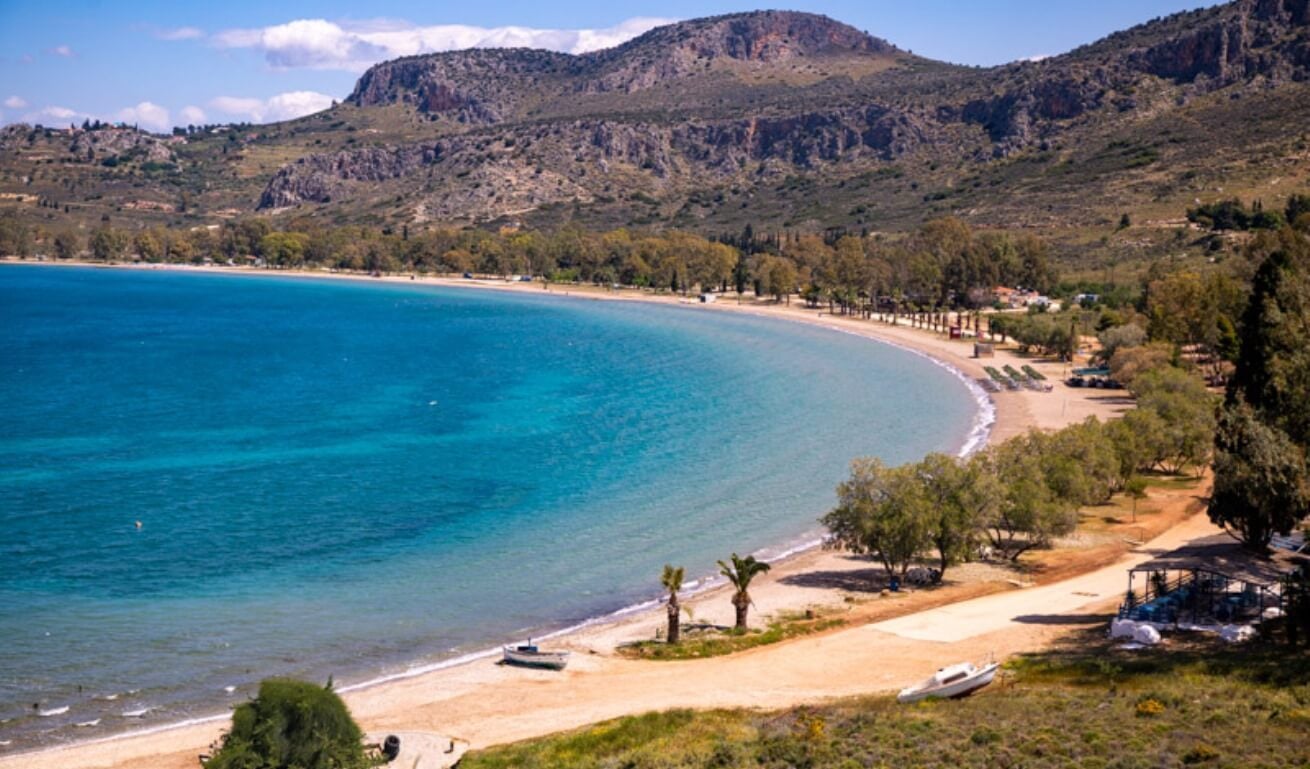
Karathona Beach
Mycenae (25 km, 30 minlutes): The legendary citadel of Agamemnon — one of the great Bronze Age kingdoms of the Mediterranean world — sits on a commanding hilltop above the Argolida plain. The famous Lion Gate, the Treasury of Atreus (a tholos tomb of staggering scale), and the royal grave circles make Mycenae one of the most viscerally exciting archaeological sites in all of Europe. Allow at least two hours. The on-site museum includes reproductions of the golden grave goods (the originals are in Athens). Go first thing in the morning to beat the coaches.
Ancient Epidaurus (28 km, 35 minutes): The sanctuary of Asclepios — god of healing — with its extraordinary 4th-century BCE theatre, is one of the supreme experiences of any trip to Greece. The theatre, capable of seating 14,000 spectators, has acoustics so perfect that a coin dropped on the orchestra floor can be heard clearly in the back row. Test it yourself. The sanctuary ruins surrounding it — temples, baths, guest houses, gymnasium — evoke a whole ancient world of medicine and drama.
Tiryns (5 km, 10 minutes): One of the great and under-celebrated sites of Mycenaean Greece, Tiryns is practically on Nafplio’s doorstep — and almost entirely ignored by the tour buses. The Cyclopean walls, built from boulders so massive that later Greeks believed they could only have been moved by a one-eyed giant, are more immediately overwhelming than anything at Mycenae. A visit of 45 minutes, ideally combined with Mycenae on the same day, is deeply rewarding.
Nemea and the Ancient Games (40 km, 45 minutes): The site of the ancient Nemean Games — one of the four great Panhellenic athletic festivals of antiquity — is one of the great overlooked gems of the Peloponnese. The ancient stadium, with its stone starting blocks and the tunnel through which athletes entered the arena (where some scratched their names into the walls), is extraordinary. The temple of Zeus at Nemea is partially restored. And the surrounding wine country produces some of Greece’s finest reds. A wonderful full day combining archaeology, wine tasting, and countryside.
Ancient Corinth and the Corinth Canal (80 km, 1 hour 10 minutes): The spectacular Corinth Canal — slicing the Peloponnese from mainland Greece through a sheer limestone gorge 79 metres deep — is one of the engineering wonders of 19th-century Europe and is staggering to behold. Combine it with the ruins of Ancient Corinth, including the well-preserved Temple of Apollo, and the views from Acrocorinth — a fortress-capped mountain with 360-degree panoramas over two seas — for a rich and varied day.
Hydra by ferry via Ermioni (Ermioni is 90 km, 1 hour 20 minutes; ferry to Hydra then 30 minutes): Drive south through the Argolida to the charming harbour town of Ermioni, leave the car, and take the short ferry crossing to Hydra — the car-free Saronic island of bougainvillea, donkeys, and breathtaking harbourscapes. Hydra is one of the most beautiful islands in Greece, and the day trip from Nafplio — combining a lovely Peloponnesian drive with island escapism — is one of the finest experiences in the whole region.
Mystras (140 km, 1 hour 40 minutes): For those who can manage the distance, the Byzantine ghost city of Mystras — a UNESCO World Heritage Site on a dramatic mountainside above Sparta — is one of the most haunting and magnificent sites in Greece. The ruins of palaces, churches, and monasteries climb the hillside in a state of extraordinary preservation; the frescoes in the churches are among the finest surviving examples of late Byzantine art. A long day from Nafplio, but unforgettable.
Tolo Beach (12 km, 20 minutes): For a relaxed beach day without drama or archaeological effort, the long sandy beach at Tolo — a small resort town south of Nafplio — is the local favourite. The drive through citrus groves is charming, and the beach itself offers calm, shallow water ideal for families. Summer ferries also depart from Tolo to the island of Spetses.
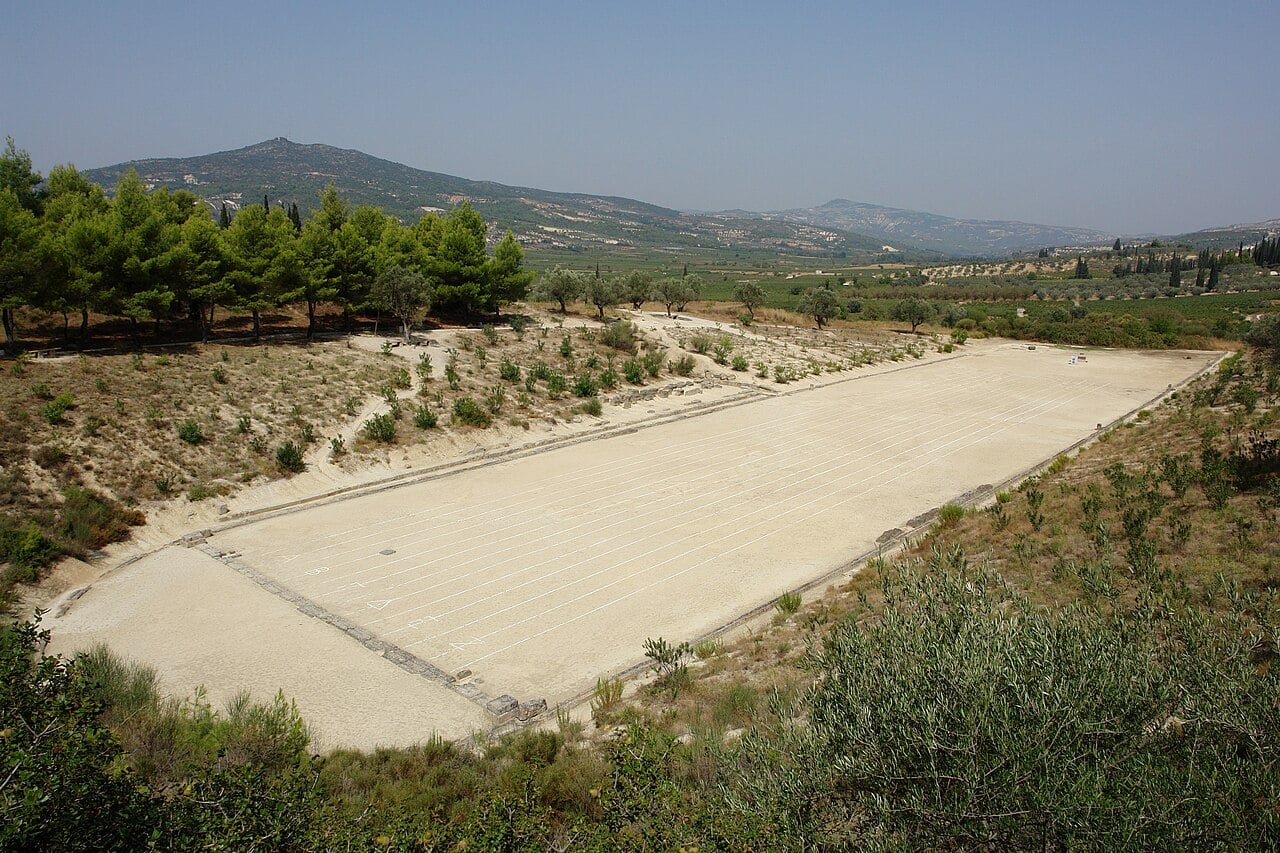
Ancient Nemea
The accommodation landscape in Nafplio is one of its great pleasures. The old town is dense with boutique hotels and guesthouses occupying restored neoclassical mansions, Venetian townhouses, and 19th-century residences — almost every room tells a story, and in some properties the stone walls, wooden ceilings, and period furnishings make you feel as though you are sleeping inside the history of modern Greece itself.
Here are 7 of the best hotel options in Nafplio:
Regno Di Morea – A stylish adults-friendly boutique hotel right in the center of Nafplio. Elegant rooms, modern design, and excellent service make it ideal for couples and romantic weekends. Rated exceptionally high by guests.
Perivoli Country Hotel & Retreat – A peaceful countryside retreat just outside Nafplio with beautiful mountain views and a relaxing atmosphere. Great for travelers who want nature, quiet luxury, and a pool experience. Family-friendly as well.
Ennea Muses Rooms and Suites – A charming boutique stay in the heart of the old town. Known for its cozy atmosphere, tasteful decoration, and excellent breakfast. Perfect for walking access to cafés and historical attractions.
King Othon Boutique Hotel – A modern boutique hotel with sophisticated rooms and a premium city-center location. Excellent choice for couples looking for comfort and contemporary aesthetics close to the old town.
Polyxenia Hotel – A classic and reliable 4-star hotel with spacious cosy rooms. Ideal for families or travelers arriving by car thanks to easy parking and quiet location.
Impero Luxury Suites – The luxury icon of Nafplio, built above Akronafplia with panoramic sea and castle views. Best suited for a high-end romantic escape with premium facilities and spectacular scenery.
For more hotel offers in Nafplio, check here!
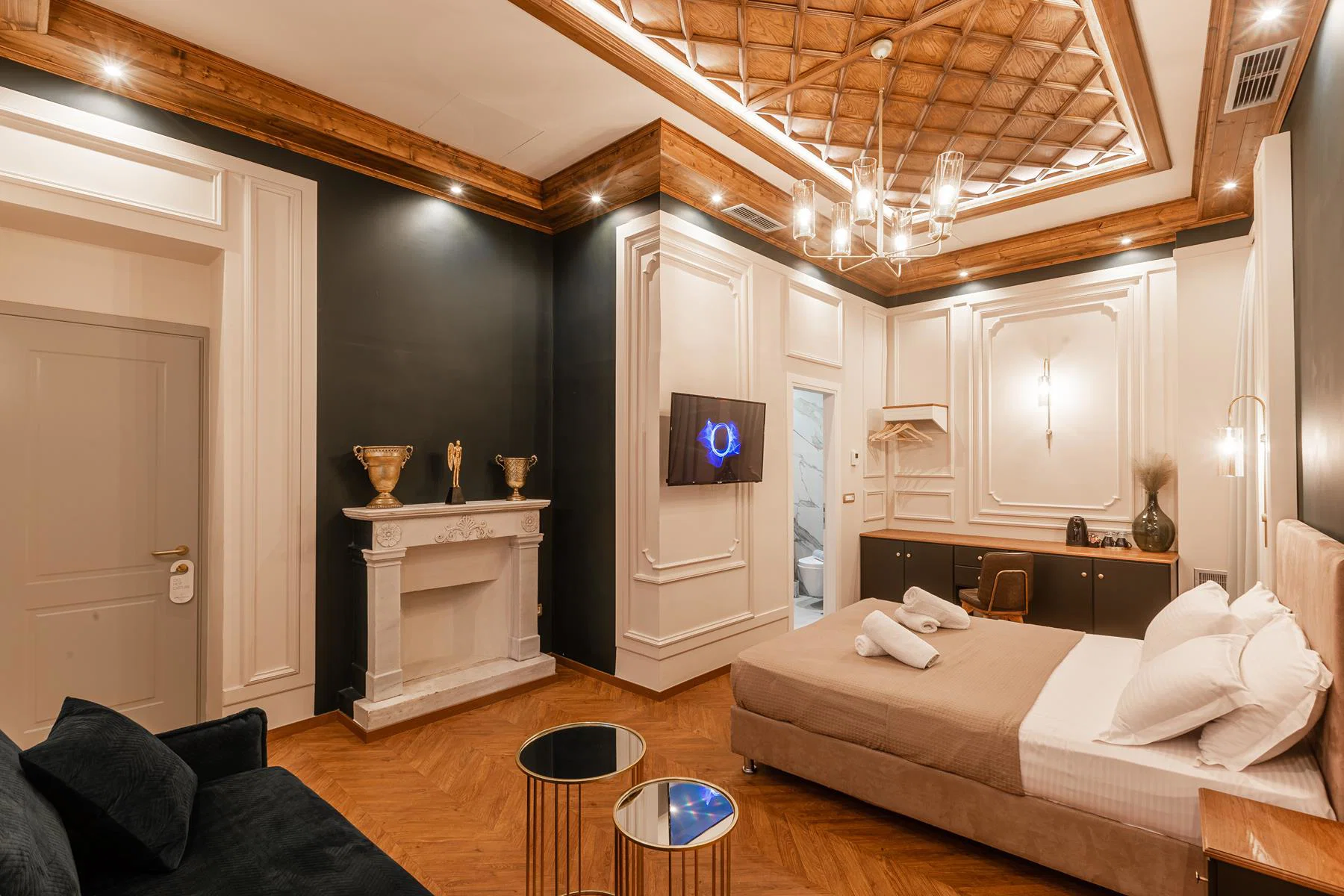
King Othon Hotel
On Foot: Nafplio’s old town is entirely walkable — indeed, many of its streets are pedestrianised or cobbled lanes where cars cannot reach. From the land gate to the far end of the promenade is less than 20 minutes on flat ground. The old town itself rewards wandering without a destination: getting pleasantly lost in the maze of alleyways is one of the great Nafplio experiences. The main challenge is the climb to Palamidi, which requires good shoes and reasonable fitness.
By Car: A car is invaluable for day trips — Mycenae, Epidaurus, Nemea, and the surrounding beaches are all easily reached by road, and the freedom to leave when you choose is worth having. The old town itself is largely closed to traffic and parking in the centre is limited; most hotels will advise on the nearest municipal parking. Driving from Athens takes approximately 2 hours on the excellent Moreas Motorway.
By Local Bus (KTEL): The KTEL Argolidas bus network connects Nafplio to Athens several times daily and also provides local services to Tiryns (10 minutes), Argos, and Tolo. The bus station is near Kolokotronis Park at the edge of the old town. For Mycenae and Epidaurus, local buses run but with limited schedules — check timetables carefully and note that doing both sites in one day by bus is very difficult.
By Taxi: Taxis are readily available in Nafplio and relatively affordable for local journeys. The taxi rank is on the main road at the edge of the old town. For day trips to Mycenae or Epidaurus, a taxi for the day — negotiated in advance — is an excellent option and allows you to combine sites flexibly.
By Boat: In summer, small excursion boats operate from the harbour to Bourtzi (10 minutes), to Karathona Beach (15 minutes), and to Tolo (from where you can connect to the island of Spetses). These water taxis are a charming and practical way to reach the beaches without driving.
By Bicycle: Several shops near the old town rent bicycles by the day, and the flat roads of the Argolida plain make cycling through the orange groves and olive orchards deeply enjoyable. The direct circuit to Tiryns and back is easily managed in two hours.
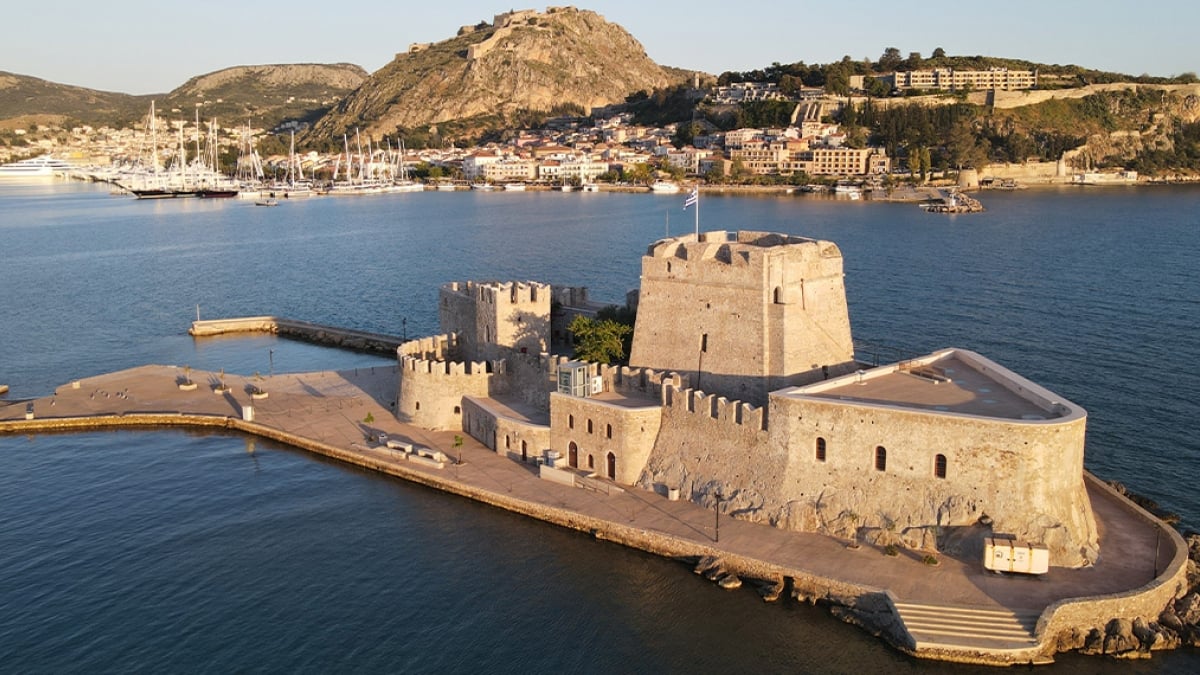
Bourtzi
Nafplio is one of the safest cities in Greece — crime is genuinely rare, the atmosphere is relaxed and welcoming, and the strong local sense of civic pride means the town is well-maintained and pleasant to navigate at all hours. Solo travellers, couples, and families all feel instantly comfortable here. The population is used to visitors but not overwhelmed by them, and the hospitality has a warmth that feels genuine rather than performative.
Wear good shoes: The cobblestone streets of the old town are charming but uneven. Flat, comfortable shoes are essential — heels are frankly inadvisable. If you plan to climb Palamidi, proper walking shoes are a non-negotiable.
Book accommodation early: Nafplio is extraordinarily popular with Athenians for weekend escapes, and the finest boutique hotels fill weeks or even months in advance — particularly on weekends from April through October. If you have a specific property in mind, book as early as possible.
Visit Palamidi early: In summer, the climb to the fortress is best made before 9 AM or after 5 PM. The midday heat on those 999 steps is formidable, and the fortress itself becomes busy with tour groups by mid-morning.
Explore the Gialos neighbourhood: The historic neighbourhood at the base of the Acronafplia cliffs — one of the oldest continuously inhabited parts of the town — is a wonderfully atmospheric alternative to the main tourist streets. Its small houses painted in deep salmon pinks, dusty yellows, and forest greens have an intimacy and authenticity that the busier lanes of the upper town sometimes lack.
Carry cash: While larger restaurants and hotels accept cards, many smaller tavernas, bakeries, and market stalls operate on a cash-only basis. ATMs are plentiful on and around Syntagma Square.
The Wednesday and Saturday market: A genuine, bustling street market fills the roads near Kolokotronis Park on Wednesday and Saturday mornings — local produce, honey, olives, cheese, and handmade goods. An excellent place to stock up on Argolida provisions for a picnic at Mycenae or Tiryns.
Tipping: Not compulsory in Greece, but appreciated. A tip of 5–10% in restaurants where you have been well looked after is the norm. Rounding up the taxi fare is the usual practice.
Power sockets: Greece uses Type C and F sockets, standard across continental Europe. Travellers from the UK will need a standard European travel adaptor.
Emergency Numbers — Save These Just in Case!
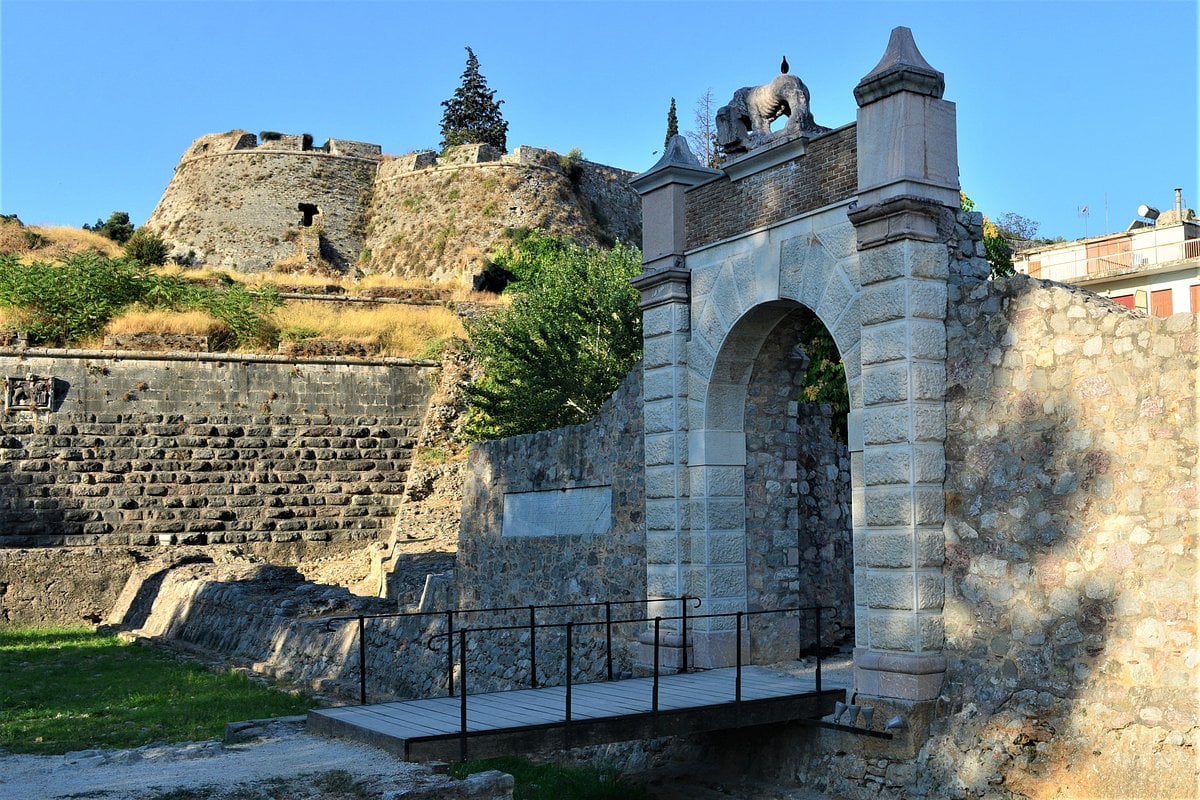
The Land Gate
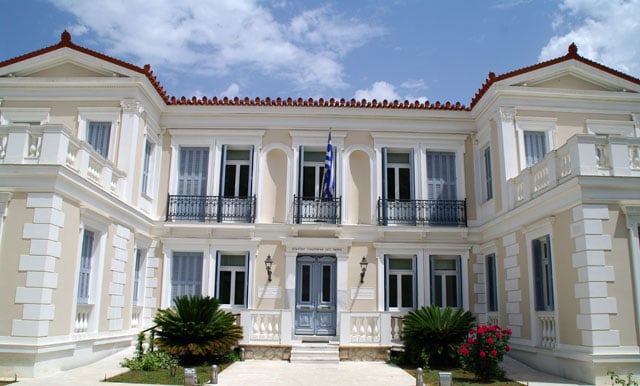
The National Gallery of Nafplio
Nafplio is a city that gives generously and asks very little in return. You do not need to study for it, or push hard, or plan with great precision. You need only to arrive, to walk through the old Venetian gate, and to surrender to the extraordinary accumulated beauty of the place — the layers of history visible in its stones, the warmth of its people, the quality of its food and wine, the Mediterranean ease with which it holds its past without being crushed by it.
There is a particular pleasure in discovering that modern Greece began here — in these tight streets and flower-filled squares, in this sun-warmed neoclassical architecture, in the bullet hole still in the church door. History is not theatrical in Nafplio, not performed for tourists. It is simply present, woven into the fabric of an ordinary, living city. And that, more than any fortress or famous square, is what you take away.
Come in May, when the orange groves are ripening and the light is kind. Walk up to Palamidi at dawn. Eat a long lunch by the harbour. Drive to Mycenae in the morning and Epidaurus in the evening. Drink a carafe of Nemea red as the sun slides behind the mountains. And understand, finally, that you have spent time in one of the genuinely great small cities of Europe — a place that rewards not rushing, not spectacle-chasing, but simply the art of being present and paying attention.
Kalo taxidi — happy travels to magnificent Nafplio. 🏛️