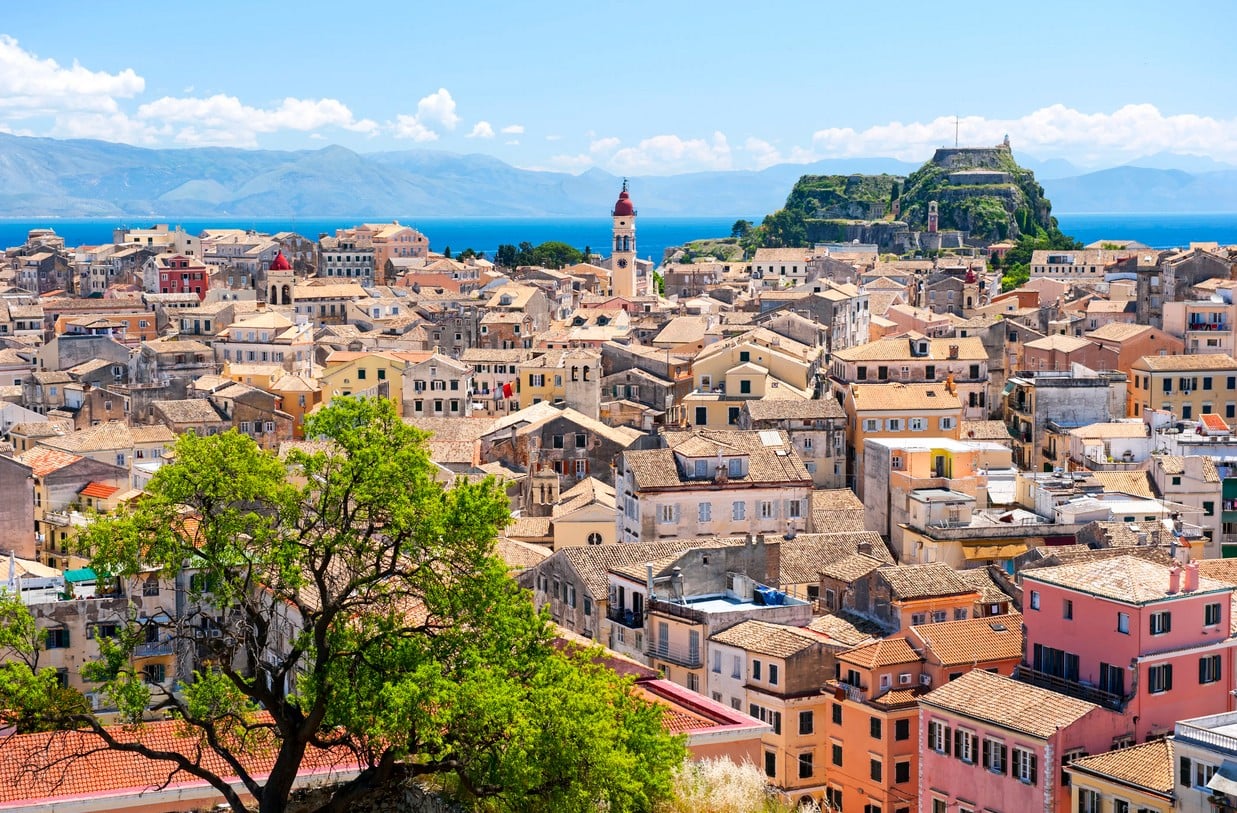
Corfu arrives differently to every visitor. For some it is the colour first — that impossible layering of jade-green hills tumbling into a sea that shifts from turquoise to deep sapphire before your eyes. For others it is the architecture — the Venetian campaniles and Parisian arcades of Corfu Town, the crumbling olive groves and Byzantine monasteries that appear without warning along a winding coastal road. For others still it is the smell: wild herbs crushed underfoot on a clifftop path, jasmine thick in the evening air of a harbour promenade, the salt and cedar of a boat bobbing in a sheltered cove.
Corfu — or Kerkyra, as every Greek knows it — is the greenest island in Greece and one of the most beautiful islands in the entire Mediterranean. Lying just off the northwestern coast of Greece opposite the mountains of Albania and Epirus, it was born at a crossroads of civilisations and has been shaped by every one of them. The Venetians ruled here for four centuries and left their soul embedded in every stone. The French came and built arcades. The British arrived and built cricket pitches and ginger beer factories. None of them left unchanged, and neither will you.
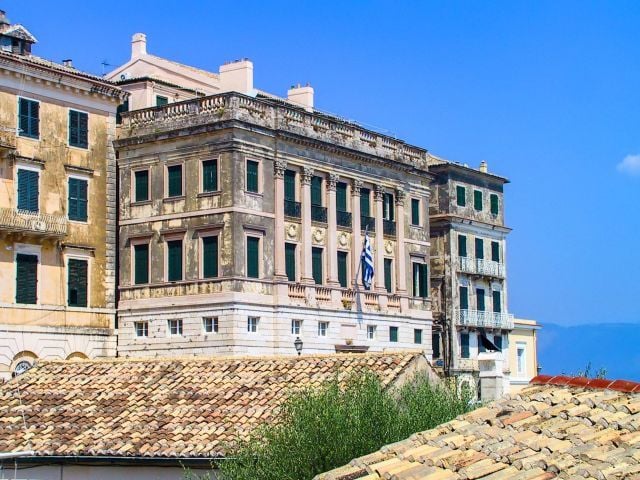
Four hundred years of Venetian elegance — and the best sunsets in the Ionian Sea.
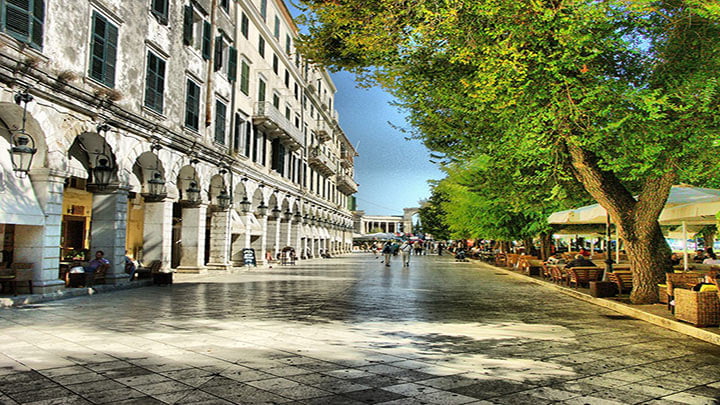
Spiandra Square
A Brief History of Corfu
To understand Corfu is to understand how many great empires looked at this island and thought: we must have this. Its position at the entrance to the Adriatic Sea made it one of the most strategically coveted pieces of land in the Mediterranean for over two and a half millennia.
According to ancient mythology, Corfu is the island of Phaeacia — the enchanted land where the shipwrecked Odysseus was received by King Alcinous and his daughter Nausicaa, and from which he was finally sent home to Ithaca. In historical time, the island was colonised by the Corinthians in 734 BC, establishing one of the earliest Greek colonies in the western Mediterranean, and its quarrel with Corinth is cited by Thucydides as one of the sparks that ignited the Peloponnesian War.
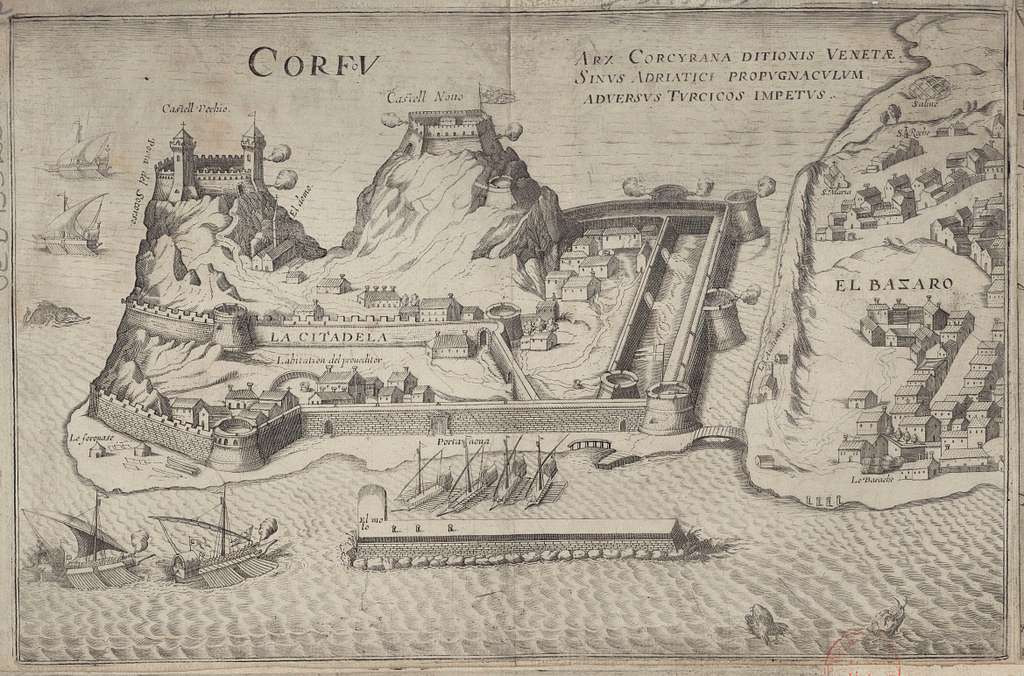
The Romans came, and after them the Byzantines, and after them the Normans, who left little behind but a memory of conquest. Then, in 1386, began the period that would define Corfu more than any other: four hundred years of Venetian rule. The Venetians transformed Corfu Town, fortifying it with extraordinary double fortresses, planting the vast olive groves that still cover the island’s interior (three to four million trees, by most estimates), and weaving their language, their architecture, and their temperament into the very fabric of Corfiot life. To this day, Corfu Town has a quality that no other Greek city possesses — something unmistakably Italianate, something of the Venetian lagoon translated into Greek sunshine.
Napoleon dissolved the Venetian Republic in 1797and acquired Corfu briefly; the French built the Liston arcade, modelled on the Rue de Rivoli in Paris, and introduced the concept of the public promenade. Then came the British, who administered the Ionian Islands as a Protectorate from 1815 to 1864, leaving behind roads, an aqueduct, an impressive palace, and — improbably — a passion for cricket that endures to this day on the Spianada square in the heart of Corfu Town.
In 1864, the Ionian Islands were united with Greece, and Corfu became Greek in name as it had long been Greek in soul. The 20th century brought occupation, bombardment during both World Wars, and eventual recovery. Today, Corfu is one of Greece’s most visited islands — and one of its most deserving.
Map of a Venetian fortress in Corfu
How to Get to Corfu from the UK
Corfu is among the most accessible Greek islands for British travellers, with a wide range of direct flight options throughout the spring and summer season.
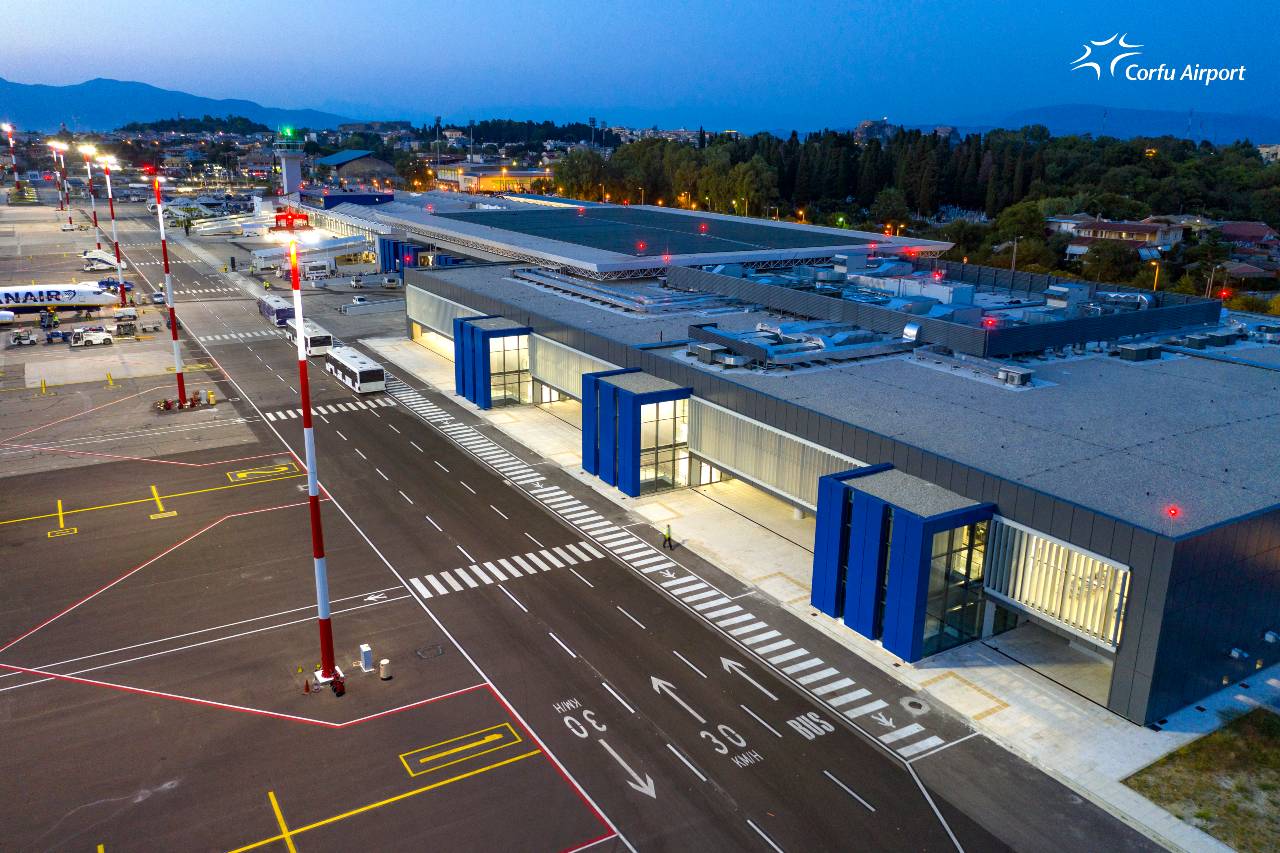
By Air:Corfu International Airport — officially named Ioannis Kapodistrias (CFU) — sits at the southern edge of Corfu Town and is served by direct flights from across the United Kingdom throughout the tourist season (typically April to October). Major airliners operate routes from London Gatwick, London Stansted, Manchester, Birmingham, Bristol, Edinburgh, and other regional airports.
Flight times are approximately 3 hours and 15 minutes from London. Outside the peak summer months, direct flights reduce significantly; year-round travellers may need to connect through Athens. Book your tickets from Skyscanner.
Getting from Corfu Airport into Corfu Town:
Taxi: The airport is just 3 km from Corfu Town — the most convenient option for most arrivals. Fixed taxi fares apply and the journey takes approximately 10 minutes. Agree the fare before you depart or confirm the meter is running.
Bus (KTEL): A local bus service connects the airport to the main bus terminal in Corfu Town. Affordable and perfectly adequate for independent travellers with light luggage.
Car Rental: Several car rental companies operate directly from the airport. Collecting a car at arrival is an excellent option if you plan to explore beyond Corfu Town — the island’s winding roads and hidden coves reward those with their own transport.
Pre-booked Transfer: For families or groups, a pre-booked private transfer is often the most practical option and can be arranged through your accommodation.
Book flights at least 8–10 weeks in advance for summer travel, and aim for April, May, or early October for the best combination of weather, value, and availability.
International Corfu Airport “Ioannis Kapodistrias”
Best Time to Visit Corfu: Weather & Seasons
Corfu enjoys one of the most appealing climates in the Ionian Islands — warmer and wetter than the Cyclades, lush and green through much of the year, with long summers and genuinely mild winters that keep the olive groves alive and the landscape extraordinary.
Month
Avg. Temp
(°C)
Sea Temp
(°C)
Sunshine
(hrs/day)
Crowd Level
April
16–20°C
17°C
7
Low ✓ Best
May
20–25°C
19°C
9
Low–Medium ✓ Best
June
24–29°C
22°C
11
Medium
July
27–33°C
25°C
12
High – Peak Season
August
27–34°C
26°C
12
Very High – Hottest Month
September
23–29°C
24°C
10
Medium ✓ Also Excellent
October
18–23°C
21°C
7
Low ✓ Excellent
Best Season to Visit Corfu: The ideal time to visit is late April through early June, and again in September and October. In spring, the island is at its most breathtakingly green — the wildflowers are out, the hillside paths are fragrant with herbs, the sea is warming, and the resorts are quiet. September brings the best of everything: warm sea temperatures, golden light, and the peaceful return of the island to itself after the summer crowds have departed. High summer (July–August) is glorious but very busy and very hot; book well in advance and book early morning activities.
Get daily weather forecasts for Corfu, in meteo.gr.
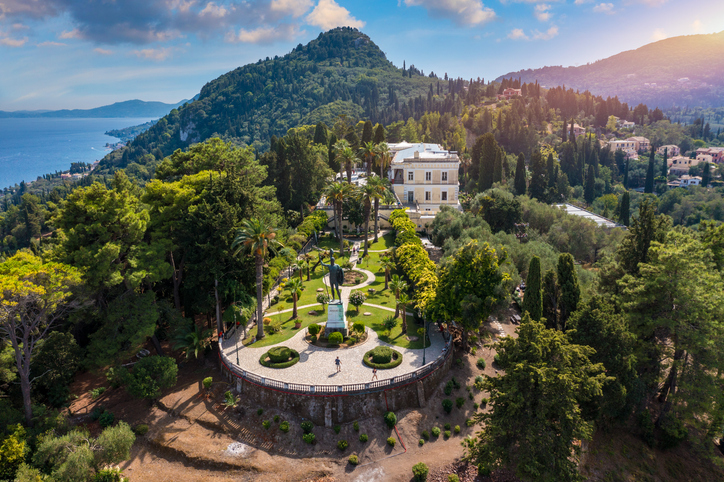
The majestic Achilleion Palace, under the Corfian sky
Top Attractions & Things to Do in Corfu
Corfu rewards the curious traveller in ways that few Greek islands can match — not just with beaches (though they are exceptional), but with a cultural depth, architectural richness, and natural beauty that make it one of the most layered destinations in the entire Mediterranean.
Corfu Town (Kerkyra): The island’s UNESCO-listed capital is one of the most beautiful small cities in Greece — a baroque, Venetian, and Neoclassical confection of narrow lanes, belfried churches, and colonnaded squares that rewards hours of aimless wandering. At its heart, the Spianada — the largest square in Greece — separates the Old Fortress from the elegant arcades of the Liston, where Corfiot society has been meeting for a morning coffee under the arches since the days of Napoleon.
The Old Fortress (Paleo Frourio): The ancient Venetian fortification that guards the eastern tip of Corfu Town — its twin peaks rising dramatically from the sea. A walk to the top rewards you with extraordinary views across the Albanian coast, the Ionian Sea, and the terracotta rooftops of the town below.
The New Fortress (Neo Frourio): The second of Corfu’s great Venetian defensive works, built in the 16th century and still presiding magnificently over the western edge of the Old Town. Less visited than the Old Fortress but arguably more atmospheric, with labyrinthine tunnels, secret passageways, and a small harbour beneath.
The Achilleion Palace: Built in 1890 for Empress Elisabeth of Austria (“Sisi”) and later acquired by Kaiser Wilhelm II of Germany, this extraordinary neoclassical palace south of Corfu Town is set among terraced gardens of exceptional beauty, filled with classical statuary and overlooking the sea. The giant bronze Achilles that dominates the upper terrace is one of Corfu’s most iconic sights.
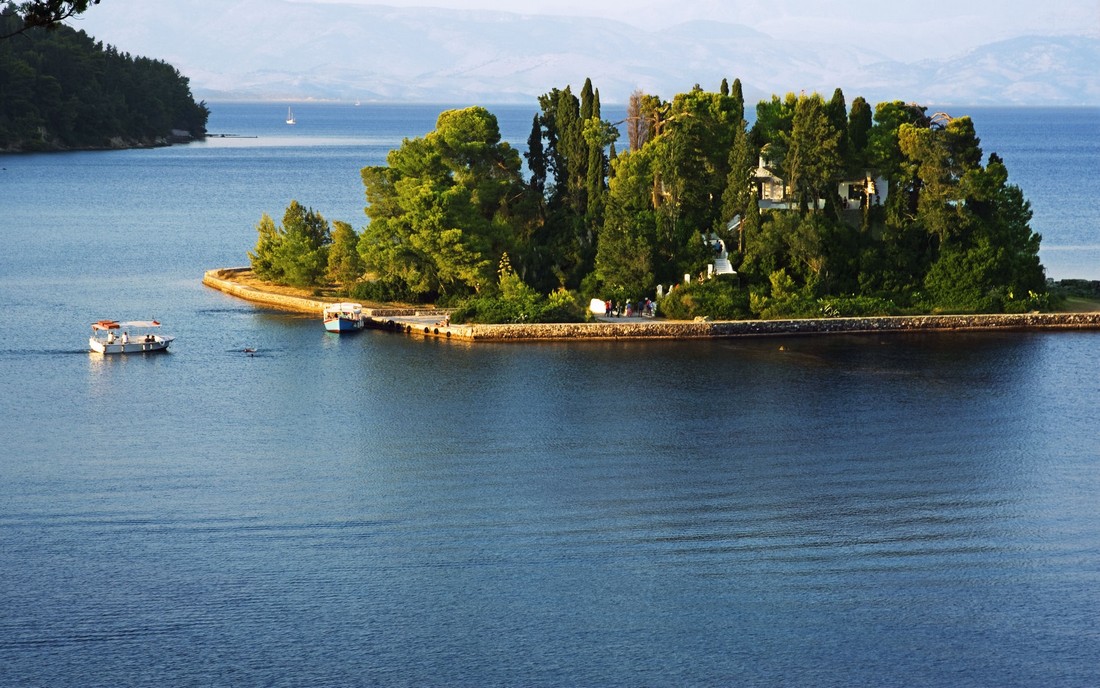
Kanoni & the Mouse Island (Pontikonisi): One of the most photographed views in all of Greece — the tiny Byzantine chapel of Pantokratoron its cypress-crowned islet, reflected in the still waters of the Halikiopoulos Lagoon. Reached by a small rowing boat from the Kanoni peninsula, just south of Corfu Town.
The Church of Saint Spyridon: The most revered church on the island and one of the most beloved in all of Greece — a 16th-century building in the heart of Corfu Town housing the silver-encased relics of Saint Spyridon, patron saint of Corfu. On four feast days each year, his remains are carried through the streets in solemn, magnificent procession.
The Antivouniotissa Museum (Museum of Byzantine Art): One of the finest collections of Byzantine and post-Byzantine icons in the world, housed in a 15th-century church in Corfu Town — an extraordinary, undervisited treasure.
Mon Repos Palace: A Regency-era villa set in lush parkland on the Kanoni peninsula, built by the British Lord High Commissioner in 1831 and notable as the birthplace of Prince Philip, Duke of Edinburgh.
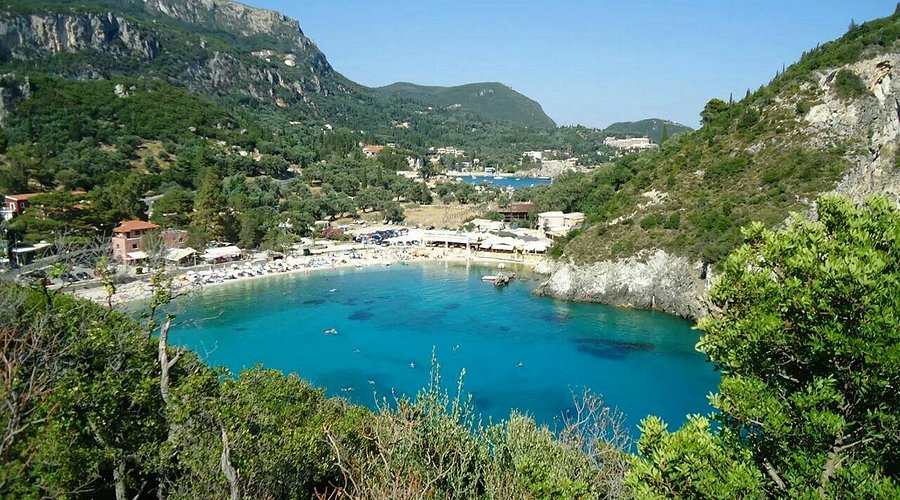
Paleokastritsa: The most celebrated beauty spot on the island — a series of crystal-clear turquoise bays nestled between dramatic limestone cliffs on the northwest coast, crowned by the iconic monastery of Theotokos. Arrive early, before the tour boats, and the effect is transcendent.
Corfu Cricket Grounds (The Spianada): An only-in-Corfu spectacle — cricket has been played on this vast central square since the British Protectorate, and the Corfu Cricket Association remains one of the oldest cricket clubs outside England. On summer weekends, matches are still played here in the shadow of the Venetian fortresses.
The House of Ioannis Kapodistrias: The birthplace and family home of Ioannis Kapodistrias (1776–1831), the First Governor of liberated Greece. His neoclassical family mansion in the heart of Corfu Town is a place of genuine historical pilgrimage, and his story — diplomat, statesman, patriot, and tragic figure — is one of the great untold stories of 19th-century Europe.
Paleokastritsa Monastery: A scenic 13th-century Byzantine monastery perched above turquoise bays on Corfu’s northwest coast, known for its beautiful views, church, and small icon museum (modest dress required).
Gardiki Castle: A quiet 13th-century Byzantine fortress near Agios Mattheos, notable for its octagonal shape, ruins, and peaceful, atmospheric setting.
Angelokastro: A dramatic cliff-top Byzantine fortress on the northwest coast, offering stunning sea views and historic significance as a refuge during Ottoman attacks.
Ioannis Kapodistrias Mansion
Best Beaches in Corfu
Corfu’s coastline is one of the most varied and beautiful in the Ionian Sea — from dramatic northwest cliff-coves of blinding turquoise to long sandy west-coast strands whipped by the afternoon breeze, and sheltered, shallow east-coast bays perfectly suited to families. Whatever kind of beach you are looking for, this island has it — and then some.
Paleokastritsa:The crown jewel of Corfu’s beaches — not one beach but six interconnected coves on the northwest coast, each framed by towering limestone cliffs and filled with water so clear and so vividly turquoise it seems almost artificial.
Glyfada: Widely considered the finest sandy beach on the island — a long, broad arc of golden sand on the west coast, backed by low dunes and a scattering of beach bars. The sea here is open and clean, the waves gently rolling in from the Ionian, and the sunsets are exceptional.
Porto Timoni: One of the most spectacular beaches in Greece — and one that must be earned. A 45-minute clifftop walk from the village of Afionasbrings you to a double-headed beach: two perfect crescents of sand and pebble separated by a narrow rocky spit, with turquoise water on both sides and sheer limestone headlands above. No facilities, no road, no noise — just one of the most beautiful places you will ever stand.
Agios Gordios: A long, sandy west-coast beach backed by dramatic green cliffs that plunge directly into the sea at both ends. Popular and well-served with tavernas and beach bars, yet with enough beach for everyone. A reliable choice for a full day — excellent swimming, good facilities, and the cliffs behind turn extraordinary colours in the evening light.
Issos & Halikounas: A wild, undeveloped stretch of dunes and sand at the southern tip of the island, backed by the protected Korision Lagoon — one of the few truly uncommercialised beaches on Corfu. The prevailing wind makes Halikounas one of the best kitesurfing and windsurfing beaches in the Ionian; the neighbouring Issos dunes are simply sublime for those seeking space, solitude, and unspoiled nature.
Sidari (Canal d’Amour): Famous for its extraordinary eroded sandstone formations — warm-coloured cliffs sculpted by the sea into arches, gullies, and narrow channels, including the legendary Canal d’Amour, through which couples swim in the belief that they will marry. The geology alone is worth the trip; the water in the sheltered channels is warm, shallow, and wonderfully clear.
Agios Spyridon & Almyros (North Corfu): Two quiet, largely undeveloped beaches in the far north of the island — long, pebbly, shallow, and surrounded by salt marshes and wetlands that make for exceptional birdwatching. Agios Spyridon is the northern terminus of the Corfu Trail and has a certain end-of-the-world remoteness that is deeply appealing.
Agni & Kalami (Northeast Coast): Two small, sheltered pebble coves on the northeastern coast — more intimate than the main west-coast beaches, with crystalline water, excellent fish tavernas right on the water’s edge, and the forested Albanian mountains rising directly across the strait.
Barbati: A popular pebbly beach on the northeast coast — one of the finest swimming beaches on that side of the island, with deep, clear, deep-blue water and the benefit of shade from the pine-covered hillside above in the afternoon. Less crowded than the west-coast sandy beaches and beloved by those who value water quality above sand.
Marathias (South Corfu): A quiet, sandy beach in the south of the island near Agios Mattheos — long, flat, and uncrowded, with shallow water ideal for children and a handful of tavernas that serve the freshest possible fish. One of the island’s most underrated shores.
Paleokastritsa Beach
Best Restaurants & Food in Corfu
Corfiot cuisine is genuinely distinctive — shaped by centuries of Venetian, French, and British influence into something that stands apart from the rest of Greek cooking. You will find dishes here that exist nowhere else in Greece: a unique culinary tradition of remarkable depth that rewards exploration.
Must-Try Corfiot Dishes
Sofrito: The signature dish of Corfu — veal escalopes cooked slowly in a rich, pungent sauce of white wine, garlic, white pepper, and parsley. A dish of pure Venetian lineage and one of the great pleasures of eating on this island. Order it wherever you see it.
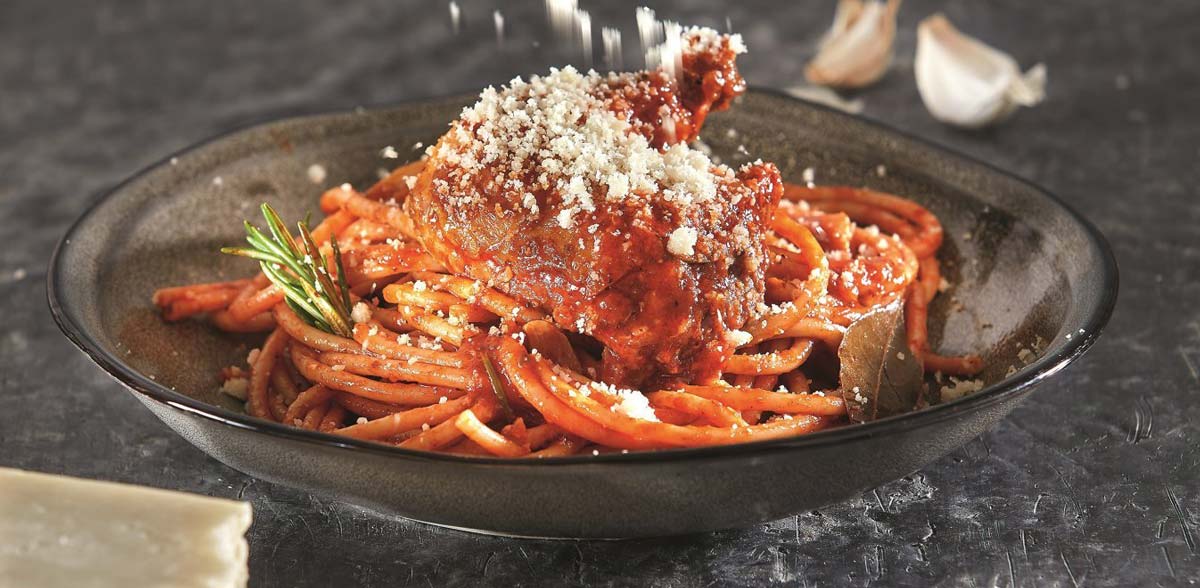
Pastitsada: Thick pasta (often cockerel, though also made with veal or octopus) slow-cooked in a spiced tomato sauce fragrant with cinnamon, cloves, and allspice — another Venetian inheritance, another reason to sit down for a long Corfiot lunch.
Bourdeto: A fiery fish stew from the fishing villages of the north — white fish (typically scorpionfish or cod) cooked in tomato and chilli in a broth that is simultaneously warming and bracingly sharp. An acquired taste for some, a revelation for others.
Bianco: A gentler fish dish than Bourdeto — white fish poached with garlic, lemon, and white pepper in a delicate, clean broth. The best version uses whatever was pulled from the sea that morning.
Kumquat Liqueur (Koum Kouat): Corfu is the only place in Europe where kumquats are commercially cultivated — introduced by the British in the 19th century — and the island produces a range of kumquat liqueurs and preserves that make exceptional souvenirs. The golden liqueur is sweet and aromatic; the white version is drier and more complex.
Tsigareli:Wild leafy greens (usually chard, spinach, or dandelion greens) cooked slowly with garlic, olive oil, and hot red pepper.A humble village dish with a strong, slightly spicy flavour — often served as a meze or light main.
Savoro: Fried fish preserved in a sauce of vinegar, rosemary, garlic, and raisins.Originally a Venetian method for preserving fish before refrigeration, now a distinctive Corfiot meze with sweet-and-sour depth.
Avgolemono Soup (Corfiot version): Chicken or fish broth enriched with egg and lemon, often lighter and more aromatic than mainland versions.Served in traditional tavernas as a comforting starter.
Stifado (Corfiot style): Slow-cooked beef or rabbit stew with onions, red wine, tomato, cinnamon, and cloves. While common across Greece, Corfu’s version reflects Venetian spice traditions and is especially rich.
Pastitsada
Best Restaurants in Corfu
Outdoor Activities & Experiences in Corfu
Corfu offers outdoor experiences that span from world-class snorkelling and sailing to mountain hiking and mountain biking — and a natural landscape that makes every one of them feel like a privilege.
Swimming & Snorkelling at Paleokastritsa: The crystal-clear waters of the northwest coves are among the most beautiful in the Ionian Sea, with visibility that can exceed 20 metres on a calm day. Rent a small boat from the beach to reach the hidden sea caves that are inaccessible from land.
Kayaking the Coastline: Sea kayaking is one of the finest ways to experience Corfu’s dramatic coastline — several operators offer guided day tours from Paleokastritsa and Kassiopi, paddling through sea caves, past limestone cliffs, and into bays reachable no other way.
Sailing the Ionian: Corfu is the gateway to the Ionian sailing circuit and one of the most popular sailing destinations in the Mediterranean. Charter bareboat or crewed yachts from Corfu Marina for day sails around the island or multi-day trips south to Paxos, Lefkada, and beyond.
Hiking the Corfu Trail: The Corfu Trail is a long-distance walking route running the full length of the island — 220 kilometres from Kavos in the south to Agios Spyridon beach in the north. The full trail takes approximately 10–12 days, but individual sections make outstanding day hikes through olive groves, mountain villages, and coastal cliffs.
Mountain Biking in the Troumpeta Pass: The mountainous interior of northern Corfu is excellent mountain biking territory — several operators offer guided tours through forested ridges, traditional villages, and dramatic sea viewpoints. The Troumpeta Pass, crossing the central ridge of the island, offers some of the finest views available anywhere on foot or by wheel.
Kitesurfing & Windsurfing at Halikounas: The long beach at Halikounas on the west coast, backed by the Korision Lagoon, is Corfu’s premier wind sports location — conditions are consistent, the beach is beautiful, and several schools operate here throughout the summer.
Birdwatching at the Korision Lagoon: A protected wetland lagoon in the south of the island, separated from the Ionian Sea by a thin strip of dunes and beach, home to flamingos, herons, egrets, and numerous passage migrants in spring and autumn. One of the finest birdwatching sites in the Ionian Islands.
Horse Riding in the Ropa Valley: The broad agricultural valley in the centre of the island offers excellent horse riding through olive groves and country lanes — several stables operate here, offering rides at all skill levels.
Diving: The clear waters around Corfu offer good diving, particularly off the northwest coast and around the Diapontia Islands to the north — several dive centres operate from the island’s main resorts.
Golf at the Corfu Golf Club: The only 18-hole golf course in the Ionian Islands, set in the lush Ropa Valley — an unexpectedly beautiful and challenging course surrounded by olive trees and the island’s green interior.
Best Day Trips from Corfu
Corfu’s position in the Ionian Sea places it within easy reach of some of the most beautiful islands and coastal landscapes in western Greece, making it an ideal base for exploring quiet offshore islets, traditional villages, and dramatic mainland scenery in a single day.
Paxos & Antipaxos: The most popular and most rewarding day trip from Corfu — two tiny, jewel-like islands just one hour south by hydrofoil or excursion boat. Paxos is a paradise of olive groves, Venetian harbours, and extraordinary sea caves (the Hypapanti Cave is among the most dramatic sea caves in the Ionian). Antipaxos, reached by a short boat ride from Paxos, has beaches — principally Voutoumi and Vrika — whose turquoise waters are among the most beautiful in all of Greece. A day here is worth any journey.
Diapontia Islands (Othoni, Erikoussa, Mathraki): Three tiny, largely unspoiled islands northwest of Corfu — reachable by ferry from the village of Agios Stefanos Avlioti. Othoni is the westernmost point of Greece; Erikoussa has an extraordinary sandy beach; Mathraki is pure, unhurried simplicity. A day trip for those seeking genuine escape.
Sivota Islands: Just off the Epirus coast, near the village of Sivota, lie a cluster of tiny emerald-green islands scattered across calm, clear water. Boat excursions from Corfu often include these small islets, where secluded coves, caves, and sheltered bays create ideal conditions for swimming and relaxed cruising. The landscape feels intimate and peaceful — a quieter counterpart to the larger Ionian islands.
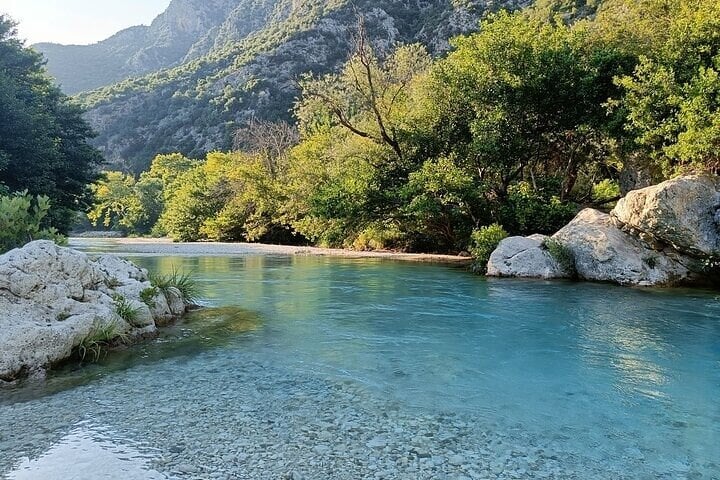
Acheron River (the Mainland): A two-hour ferry crossing from Corfu connects to Igoumenitsa on the Greek mainland, from where the legendary Acheron River — the mythological River of the Underworld — flows through a narrow gorge to the sea. Canoeing the lower Acheron in spring, through willows and plane trees, past an ancient oracle of the dead, is an experience of extraordinary atmosphere
Lefkada: Further south in the Ionian chain, Lefkada offers some of the most spectacular beaches in Greece, with towering white cliffs and luminous turquoise water along its western coast. Though too far for a simple ferry excursion, organised boat trips and multi-stop cruises from Corfu occasionally include Lefkada as part of longer Ionian itineraries. The island’s dramatic coastline, traditional villages, and famous beaches such as Porto Katsiki and Egremni make it one of the most visually striking destinations in the region.
Kefalonia: The largest of the Ionian islands, Kefalonia is a place of grand landscapes — mountains, vineyards, and deep blue bays that feel more rugged and expansive than Corfu. Excursion cruises occasionally connect the northern Ionian islands, allowing visitors to experience Kefalonia’s extraordinary coastline, hidden caves, and traditional harbours. It is less a quick day trip and more a glimpse of another Ionian world — quieter, wilder, and deeply atmospheric.
Meganisi: The small island of Meganisi is known for its hidden caves, traditional villages, and gentle, unhurried rhythm of life. Often included in Ionian island-hopping cruises, it offers a glimpse of a more secluded maritime Greece, where fishing boats, small harbours, and olive-covered hills define the landscape.
Acheron River
Where to Stay in Corfu: Best Hotels
Corfu offers accommodation to suit every type of traveller — from luxury estate hotels and boutique Old Town guesthouses to family resorts along the east coast and simple agriturismos in the island’s quiet interior.
Getting Around Corfu: Transport Guide
Corfu is a relatively compact island — about 60 kilometres from tip to tip — but its winding mountain roads and dispersed settlements make having your own transport a significant advantage for anyone wishing to explore beyond the main tourist areas.
Car Rental: The single most practical way to explore Corfu properly. Rental agencies operate from the airport, Corfu Town, and most resort areas. Roads in the north of the island are narrow and occasionally challenging; drive carefully and give way to oncoming traffic on single-track roads. Fuel stations are plentiful in the main towns but scarcer in the north.
Scooter & ATV Rental: Popular throughout the island and a practical option for solo travellers and couples exploring the coast. Wear a helmet and exercise caution on mountain roads.
KTEL Bus: The island’s public bus network connects Corfu Town with most major villages and resorts. The main KTEL terminal is on Avramiou Street in Corfu Town. Services are reliable but infrequent — plan around timetables and do not rely on buses for spontaneous exploring.
Taxi: Taxis are readily available in Corfu Town and can be pre-booked from most resorts. Agree the fare in advance for longer journeys to avoid misunderstandings.
Boat: Many of Corfu’s finest beaches and coves are accessible only by sea. Water taxis operate from Corfu Town and from the main resort beaches, and excursion boats run regular trips around the island’s coastline throughout the summer season.
Walking: Corfu Town is best explored entirely on foot — the Old Town is pedestrianised in its historic heart, and distances between attractions are short. For the island’s interior, the Corfu Trail and various waymarked routes offer outstanding walking through landscapes that can only be reached on foot.
Pontikonisi Island
Corfu Travel Tips & Safety Guide
Corfu is a safe, welcoming, and exceptionally visitor-friendly island. Crime is low, locals are warm and proud of their island, and the combination of the island’s long international history and its substantial British visitor community means that English is very widely spoken throughout.
Roads: Exercise particular caution on the mountain roads of the north, which are narrow, winding, and can be unexpectedly busy with tourist traffic in summer. Do not overtake on blind corners, and watch for scooters and cyclists.
Heat: July and August can be intensely hot, with temperatures regularly reaching 33–35°C. Carry water at all times, apply sunscreen generously, and plan hikes and extended coastal walks for early morning rather than midday.
Jellyfish: The Ionian Sea occasionally brings jellyfish close to shore, particularly in late summer. Check local conditions before swimming and ask at your accommodation if there are seasonal concerns.
Language: As elsewhere in Greece, learning a handful of Greek phrases — Kalimera! (Good morning), Efcharisto! (Thank you), Yamas! (Cheers!) — is warmly appreciated and will open every door. In Corfu, many locals also have some Italian, a legacy of the Venetian centuries.
Currency: Greece uses the Euro (EUR). ATMs are plentiful in Corfu Town and in most resort areas. Carry cash for smaller tavernas, village shops, and beach boat trips, which may not accept cards.
Tipping: Rounding up the bill or leaving 10% at a restaurant is the normal and appreciated practice. Leaving a euro or two on the table for a coffee is considered polite.
Electrical Outlets: Greece uses Type C and F plugs (Europlug). UK travellers will need a travel adapter.
Cultural Respect: Dress modestly when visiting churches and monasteries — shoulders and knees should be covered. The church of Saint Spyridon in Corfu Town is a place of active and deeply felt religious devotion; be quiet and respectful. During the Easter processions, stand respectfully and do not obstruct the procession.
Medical Facilities: Corfu General Hospital (Kapodistrias Hospital) provides public medical services. Travel health insurance with private hospital cover is strongly recommended.
Water: Tap water in Corfu is generally safe to drink, though the quality varies across the island; bottled water is inexpensive and universally available.
1. Why is Corfu so green compared to other Greek islands?
Corfu receives significantly more rainfall than the Aegean islands — its position in the northern Ionian, catching weather systems from the Adriatic, gives it a lushness quite unlike the drier Cyclades or Dodecanese. This is why the interior is carpeted in dense olive groves, cypress trees, and wildflower meadows that remain vibrantly green well into summer.
2. Why do Corfiots play cricket?
Corfu was administered by the British as part of the Ionian Protectorate from 1815 to 1864, and the British introduced cricket to the island during that period. Unlike almost everywhere else the British went, cricket actually stuck — the Corfu Cricket Association is one of the oldest clubs outside England, and matches are still played on the Spianada square in Corfu Town throughout the summer. It is one of the most delightfully improbable sights in Greece.
3. Is the island of Corfu really the Homeric Phaeacia?
The identification is ancient and much debated. In the Odyssey, Phaeacia is an enchanted island at the edge of the world, ruled by the civilised and seafaring Phaeacians, where Odysseus washes ashore and is received with legendary hospitality. The ancient Greeks identified it with Corfu, and several topographical features of the island — including a rocky offshore outcrop said to be the Phaeacian ship turned to stone by Poseidon — preserve the tradition to this day.
4. What is the connection between Corfu and Gerald Durrell?
The British naturalist and writer Gerald Durrell spent his childhood on Corfu in the 1930s with his eccentric family, and described the experience in his beloved memoir My Family and Other Animals (1956) and its sequels. The books remain among the most enchanting accounts ever written of life on a Mediterranean island, and the BBC television adaptation has introduced Corfu to new generations of British readers and travellers. The Durrell family home and several locations from the books are identifiable around Corfu to this day.
5. What makes Corfiot cuisine different from the rest of Greece?
Four hundred years of Venetian rule left an indelible mark on Corfiot cooking. Dishes like Sofrito (veal in white wine and garlic) and Pastitsada (spiced meat ragù with pasta) are of unmistakable Italian lineage. The French and British periods added further layers. The result is a cuisine that uses cinnamon, cloves, and allspice in ways you will not find elsewhere in Greece, and that has a refinement and complexity rooted in a genuinely distinct culinary history.
6. Can you swim year-round in Corfu?
In practice, most visitors swim between May and October. The sea temperature peaks at 25–26°C in August and remains comfortable (21–22°C) through October. In April the sea is brisk but swimmable for the enthusiastic; outside these months it is cold. The island’s mild winters mean that walking, cycling, and cultural tourism are perfectly enjoyable from October through to March.
7. What is the Botides ceremony at Easter?
On Holy Saturday morning in Corfu Town, at the stroke of 11am, residents hurl large clay pots filled with water from their windows and balconies onto the streets below in a tradition dating back to the Venetian period — symbolising the casting out of the old and the welcoming of the new. The sound is extraordinary, the streets run with water, and the effect — watched from a safe distance — is both hilarious and deeply moving.
8. Where does the name Kerkyra come from?
The ancient Greek name for the island, Kerkyra, derives from the mythological nymph Kerkyra, daughter of the river god Asopus, whom Poseidon carried off to the island and with whom he had a son named Phaeax — ancestor of the Phaeacians. Every time a modern Greek says “Kerkyra” they are, in some small way, reciting a line of Hesiod.
9. Why does Corfu Town feel more like Venice than Greece?
Because for nearly four centuries — from 1386 to 1797 — it was, in effect, a Venetian city. The Serenissima never lost Corfu to the Ottomans, unlike the rest of Greece, which means the island was spared the long occupation that shaped so much of the mainland’s history. The result is a townscape of narrow Venetian calli, colonnaded arcades (the famous Liston, modelled on the Rue de Rivoli), pastel-shuttered campanili, and an aristocratic register of urban life with no real parallel in Greece.
10. What is the ghost story of Mon Repos?
Mon Repos is a neoclassical villa south of Corfu Town, birthplace of Prince Philip, Duke of Edinburgh, and the setting of one of the more atmospheric episodes in modern Greek royal history. For decades after the Greek royal family’s exile the villa stood shuttered and slowly decaying, its gardens reverting to wilderness. Local Corfiots gave it a wide berth at night. When restoration finally began in the 1990s, workers reportedly refused to enter certain rooms after dark.
Corfu Travel Guide 2026: Final Thoughts
Corfu is not an island you simply visit — it is an island that happens to you. It ambushes you with a quality of beauty you were not fully prepared for: the extraordinary layering of sea and mountain and centuries-old olive grove; the Venetian campanile rising above a Greek harbour; the way a walk through the Campiello district at dusk, with the smell of jasmine and the sound of a violin from an open window, transports you somewhere that belongs equally to Venice and to Greece and finally, completely, to itself alone.
Whether you are standing at the window of the Old Fortress as the sun drops behind the mountains of Epirus and turns the Ionian Sea to copper, eating Sofrito and local Corfiot wine at a table in a lamplit Old Town square, kayaking into a sea cave on the northwest coast, or watching a clay pot shatter on the cobblestones on a Holy Saturday morning — Corfu will find you. It always does.
This is Greece at its most layered, its most European, and its most gloriously itself.
To provide the best experiences, we use technologies like cookies to store and/or access device information. Consenting to these technologies will allow us to process data such as browsing behaviour or unique IDs on this site. Not consenting or withdrawing consent, may adversely affect certain features and functions.
Functional
Always active
The technical storage or access is strictly necessary for the legitimate purpose of enabling the use of a specific service explicitly requested by the subscriber or user, or for the sole purpose of carrying out the transmission of a communication over an electronic communications network.
Preferences
The technical storage or access is necessary for the legitimate purpose of storing preferences that are not requested by the subscriber or user.
Statistics
The technical storage or access that is used exclusively for statistical purposes.The technical storage or access that is used exclusively for anonymous statistical purposes. Without a subpoena, voluntary compliance on the part of your Internet Service Provider, or additional records from a third party, information stored or retrieved for this purpose alone cannot usually be used to identify you.
Marketing
The technical storage or access is required to create user profiles to send advertising, or to track the user on a website or across several websites for similar marketing purposes.